Round or Rectangular Outdoor Trash Bins: Which Fits?
 19
 Share
Choose a rectangular outdoor trash bin when its straight sides and shallow depth suit a wall, boundary or defined furniture zone. Choose a round bin when its actual dimensions, opening positions and curved profile suit an open setting. Neither shape is automatically more accessible, stable or economical. The better choice leaves room for people to deposit waste and for staff to open, empty and clean the bin.
For landscape architects, contractors and property managers, comparing round vs rectangular trash cans is therefore a layout decision before it is a styling decision. A bin can fit inside a drawing and still obstruct a doorway, place its opening away from approaching pedestrians or leave its service door trapped against a planter. Evaluate the complete installed arrangement before approving a model for a public project.
Round vs Rectangular Trash Cans: Compare the Space You Actually Need
Start with three different spaces: the footprint occupied by the closed bin, the approach space used by the public, and the working space needed during collection. A catalogue normally gives external dimensions. Those dimensions do not automatically include an open service door, a lifted hood, a withdrawn inner liner or a cleaner handling a collection cart. Treat each of these as a separate item on the site drawing.
For a rectangular body, width multiplied by depth describes its bounding footprint. For a genuinely circular body, the diameter describes its width in every direction. However, a rounded receptacle may have a projecting hood, base or ashtray. Use the maximum external dimensions shown on the approved drawing rather than estimating a diameter from a photograph. Capacity in litres describes the waste container; it does not tell you how far the complete product projects into a path.
A useful first comparison holds the collection requirement constant. Define the waste stream, required working capacity and service interval, then shortlist shapes that can meet them. If the candidates have different capacities, retain that difference in the decision. A compact 40-litre model and a larger 60-litre model are not an equal-capacity test of geometry, even if both are described as outdoor litter bins.
Be cautious with percentage claims about square bins holding more waste. Such claims can describe a specific manufacturer's product comparison or idealised geometry. They do not establish the usable capacity or space saving of another supplier's finished receptacle. Compare the specified liner, outer enclosure and installation clearances together.
Where Does a Rectangular Single Bin Fit Best?
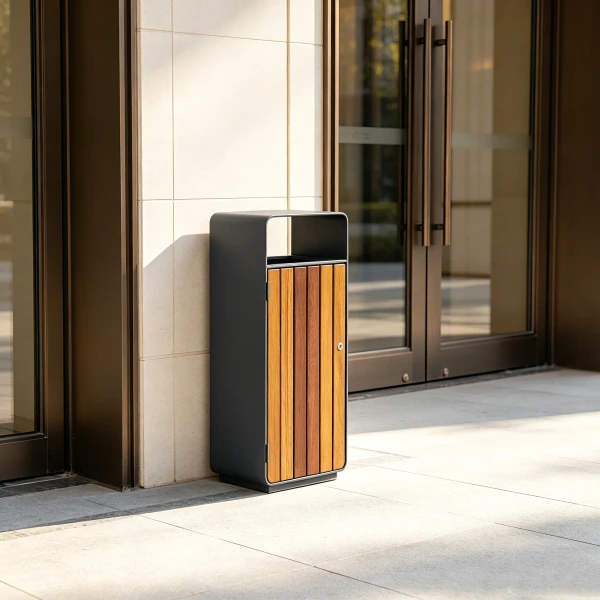
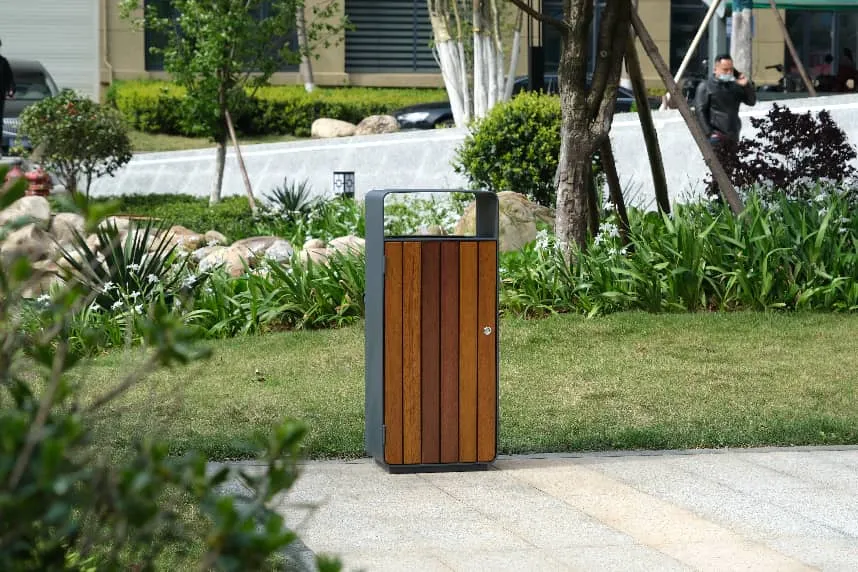
A rectangular single bin is often a practical starting point beside a straight wall, along a planter edge or within a row of street furniture. A shallow model can limit projection into the circulation area while keeping a clearly defined front facing the public. Straight sides can also make the relationship with paving joints, benches and other equipment easier to coordinate.
The advantage depends on orientation. Turning a 40-by-30-centimetre body through 90 degrees changes which dimension projects from the wall. That may improve one clearance while putting the service door or disposal opening in the wrong direction. Mark the public-facing side, hinge side and collection side on the plan instead of treating the footprint as an unlabelled rectangle.
Corners need particular care. A unit that fits tightly between two walls may leave too little room to open a side door, operate a lock or wipe the surfaces around it. A gap behind the bin may also become inaccessible for litter removal. Specify a maintainable installation, rather than trying to occupy every centimetre of the recess. The selected fixing position must support that arrangement.
Rectangular does not necessarily mean compact. A deep cabinet can project farther into a path than a smaller round receptacle. Browse the actual dimensions in LVEN's single-bin range, then compare candidates against the same available zone. Shape becomes useful when it solves a measured site constraint.
When Does a Round Public Waste Bin Work Better?

A round public waste bin can suit an open plaza, a curved landscape boundary or a location seen from several directions. Its curved outline may coordinate well with surrounding furniture and reduce the visual emphasis of a front corner. These are useful design considerations, but the public still needs a visible, reachable disposal opening on the approach they actually use.
A circular body does not provide 360-degree disposal access by itself. A covered round bin may have only one or two apertures, and an integrated ashtray may occupy part of the top. Check the openings on the specific model. At the junction of two paths, inspect the bin from both approaches; an attractive rear view is not a substitute for an opening pedestrians can find.
Also consider how the curved body meets a straight boundary. It can leave narrow spaces near a wall that are difficult to reach for sweeping. Moving the bin forward may solve cleaning access but increase its projection into the public area. In a generous landscape zone that trade-off may be acceptable. In a narrow entrance recess, another footprint may work better.
Do not choose round solely on an assumption that it will resist wind or tipping better. Performance depends on construction, base geometry, mass, fixings and the installation surface. A curved profile is not a substitute for a suitable anchoring design. For exposed locations, confirm the complete installation with the supplier and project team.
How Does Outdoor Trash Bin Shape Affect Emptying and Cleaning?
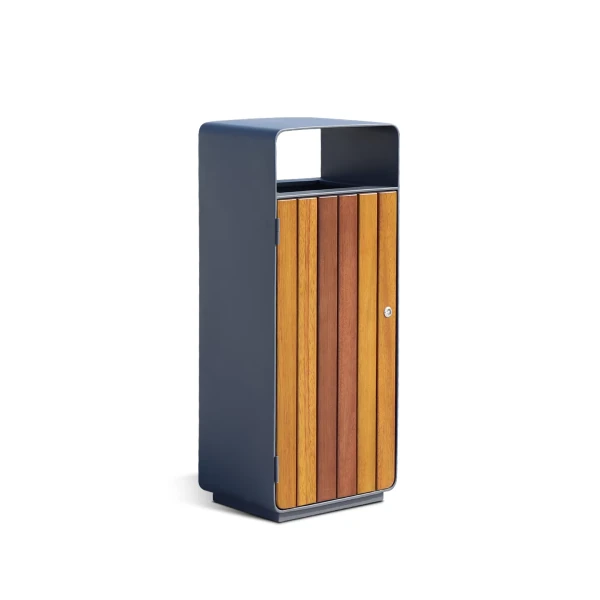
The outer outdoor trash bin shape and the inner waste container perform different jobs. A rectangular enclosure may contain a differently shaped liner; a rounded enclosure may still have seams, brackets or corners that need attention. Ask for the liner dimensions, retention arrangement and removal direction. Staff should be able to withdraw it without catching a bag on an edge or forcing the container past a restricted opening.
This is where operating design can outweigh the shell shape. Busch Systems' outdoor-bin selection guide discusses removal access, bag compatibility and internal obstructions as practical servicing concerns. Pilot Rock also offers both round and square side-door receptacles. Side access is a model feature available in either shape, rather than an inherent advantage of one outline.
During a sample review, use the intended bag and liner, then reproduce the actual collection sequence. Open the door fully, remove the liner, release the bag and return everything to its working position. Include the collection cart and the place where staff will stand. A front-opening design still needs room in front; it does not eliminate handling effort or guarantee a suitable working posture.
For cleaning, inspect the surfaces that receive spilled drinks and loose waste, the underside of the hood and the area around the base. Look for reachable edges and a liner that can be cleaned using the agreed method. Smooth curves may simplify some wiping tasks, but finish, joints and access determine the result. Avoid assuming that every round bin cleans faster than every rectangular one.
Comparing Two LVEN Outdoor Trash Bins on the Same Site Plan
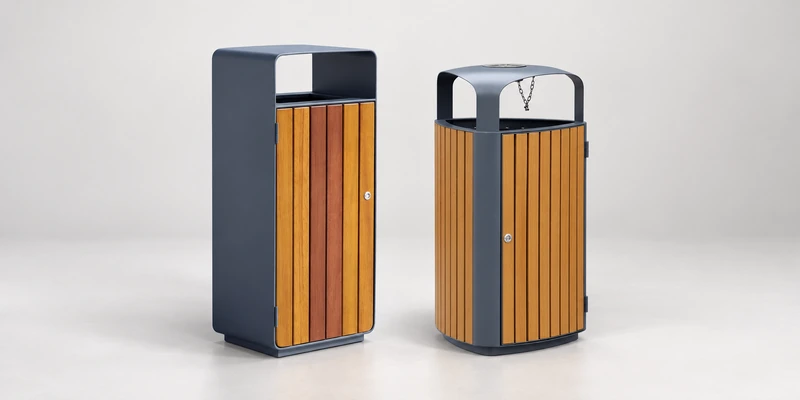
AI-generated comparison illustration based on product references; not a dimensional drawing.
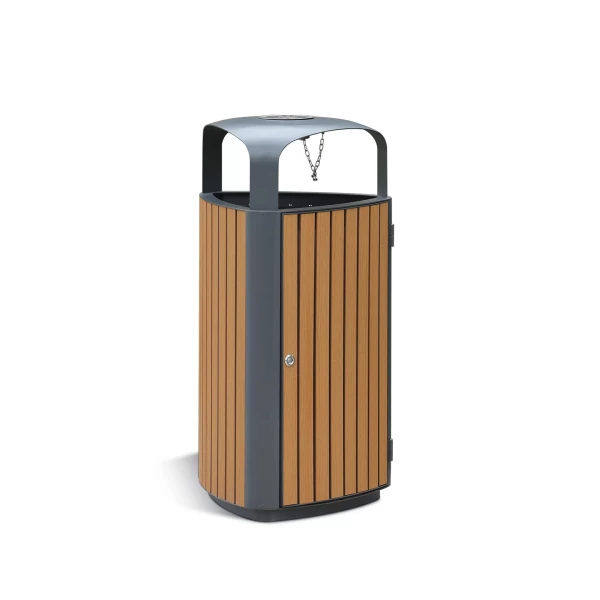
LVEN's OTM-04BM provides a rectangular example with a published 40 × 30 × 95 cm body and 50-litre capacity. It combines a powder-coated galvanized steel frame with Bintangor wood slats, a curved rain hood, a lockable service door and a removable metal inner liner. The OTM-15 has a rounded profile, published dimensions of 46 × 46 × 90 cm and 40-litre capacity, with a galvanized steel frame and PS slats.
Imagine a wall-side installation zone measuring 120 cm along the wall and 120 cm out from it. This is an illustrative planning exercise, not a required public-path width. With the OTM-04BM oriented with its 40 cm side along the wall, its stated 30 cm depth leaves 90 cm of the zone in front of the closed body. The OTM-15's stated 46 cm depth leaves 74 cm. These figures describe the unoccupied depth inside that example zone only.
Neither result establishes an acceptable circulation width. The actual route, local requirements, setbacks, base projection and collection movements still need review. Nor does the comparison prove that rectangular bins always save space: these are different products with different capacities, heights and construction details. It shows why actual model dimensions are more useful than a general shape preference.
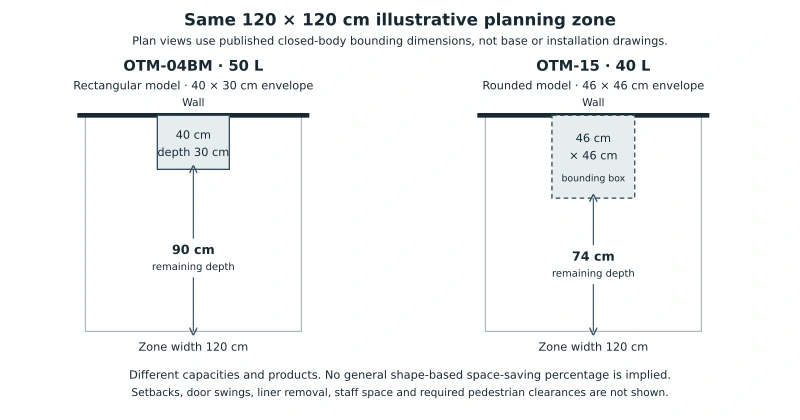
The plan views use bounding boxes for both models, including the rounded OTM-15. They show the stated closed-body dimensions only; neither drawing defines a base shape, door clearance or approved installation.
| Site condition | Rectangular model assessment | Round model assessment |
|---|---|---|
| Shallow wall-side zone | Check depth and front-door operation | Check maximum projection and cleaning behind the curve |
| Open space with several approaches | Orient the openings toward the main routes | Verify which approaches have usable openings |
| Furniture placed immediately beside the bin | Check side clearance and hinge direction | Check curved gaps and access around the base |
| Restricted collection position | Plot door, liner and worker movement | Plot the same movements using the actual model |
Take the two shortlisted outlines onto the same scaled drawing, then add opening directions and service movements. If either layout fails, change the position or model before adjusting finishes. A full-size ground marking can expose conflicts that are easy to miss on a small landscape plan.
What Should a Single Bin Specification Include?
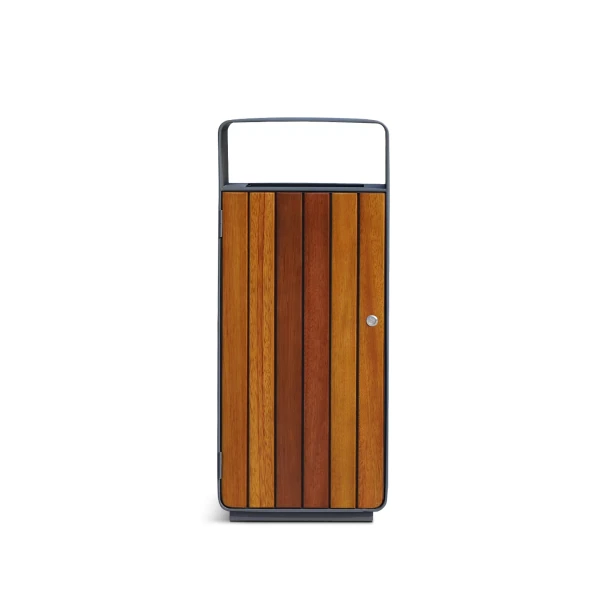
Turn the preferred layout into a specification that a supplier and installer can both check. Identify the model, quantity, external dimensions, capacity and proposed orientation. Add the public approach, service-door direction, liner removal space, surface and fixing locations. Distinguish confirmed dimensions from details still awaiting the supplier's drawing.
Keep the liner and cleaning requirements specific. Record the proposed bag dimensions, whether a rigid liner is required, the collection method and any equipment that must reach the location. For timber or PS slats, confirm the selected material and care instructions rather than treating all wood-look products as equivalent. The OTM-04BM and OTM-15 illustrate why an appearance comparison should retain the underlying material differences.
Before ordering, review one complete arrangement with the people who will use and service it. Check visibility from the public approach, access with neighbouring furniture in place, door operation and a realistic emptying sequence. If the same model will be repeated across a site, document the approved orientation so that installation does not reverse the intended benefit.
Send LVEN a marked-up site plan, the available installation dimensions and the collection requirements through the project contact page. This gives the team a practical basis for comparing suitable outdoor trash bins and confirming drawings, materials and project options before production.
FAQ About Round vs Rectangular Outdoor Trash Bins
Is a round or rectangular outdoor trash bin better for a narrow path?
Compare actual depth and operating clearances. A shallow rectangular model may suit a wall-side location, but a smaller round model can also work. Keep the required pedestrian route clear and test the service door and liner removal separately from the closed footprint.
Can a round outdoor trash bin be used from every direction?
Only if its opening arrangement permits it. A round body with one covered aperture has a defined disposal side. Check the number, position and visibility of the openings on the selected product rather than relying on the silhouette.
Does a square outdoor bin hold more waste than a round bin?
There is no universal product-level answer. Capacity depends on the liner, enclosure, height and internal components. Compare stated usable capacities and external dimensions; do not transfer an idealised geometric ratio or another manufacturer's percentage claim to an unrelated model.
Contents