
How to Choose Outdoor Trash Bins for Parks, Streets and Commercial Areas?
 152
152  Share
Share
Summary
Choosing the right outdoor trash bin is not only about size or appearance. For parks, streets, commercial plazas, schools, scenic areas, and municipal projects, the right bin affects cleanliness, maintenance cost, pedestrian flow, recycling behavior, and the long-term image of the space.
A good outdoor waste bin should match the site scenario, expected foot traffic, waste type, collection frequency, material requirements, installation method, and local maintenance capability. Buyers also need to consider corrosion resistance, inner liner design, recycling separation, lid opening, anti-theft structure, cleaning efficiency, and whether the supplier can support customization and bulk project delivery.
This guide explains how to evaluate outdoor trash cans for public space projects and includes a practical purchasing checklist for contractors, distributors, municipal buyers, and commercial property managers.
What Makes an Outdoor Trash Bin Suitable for Public Projects?
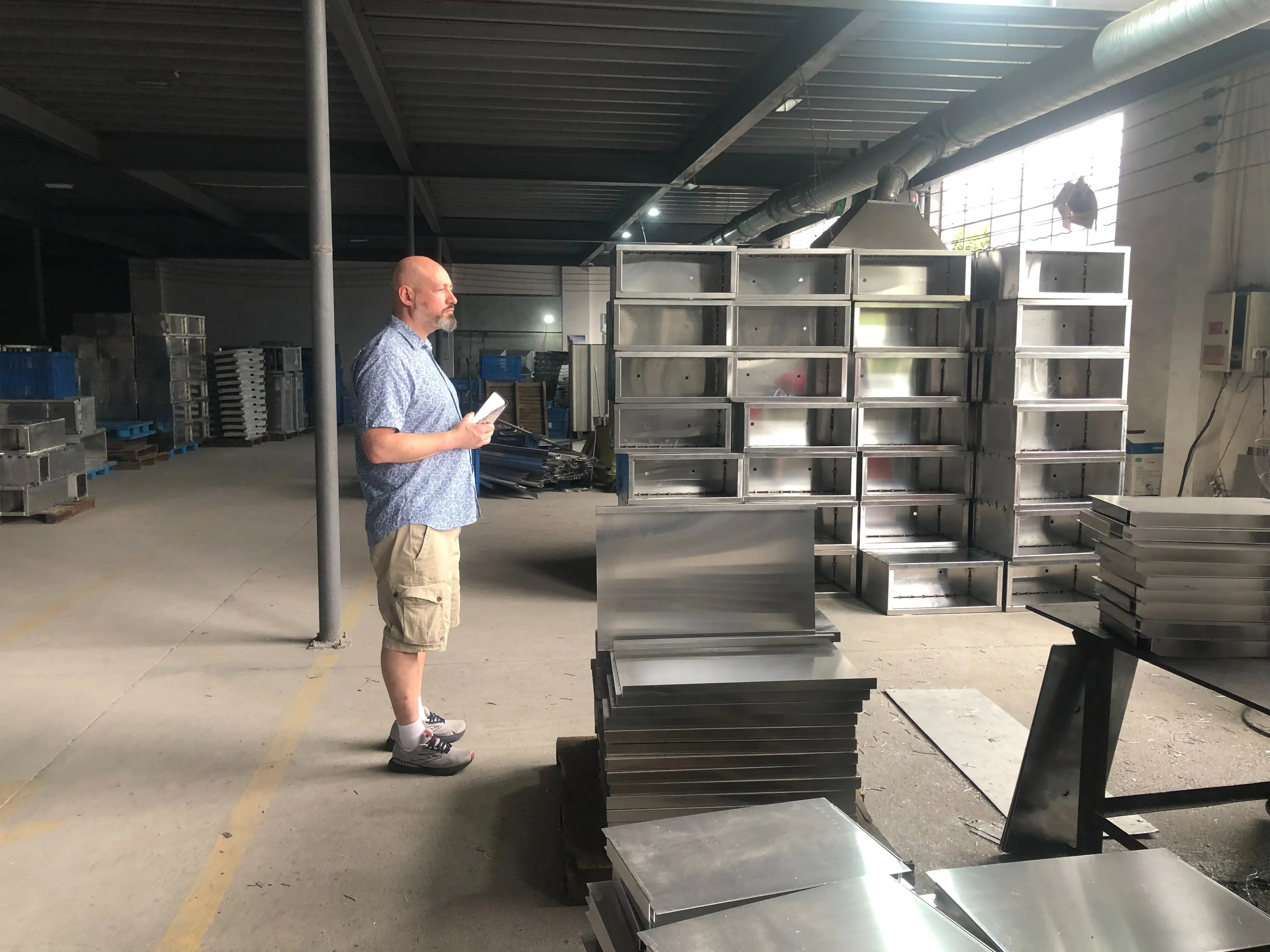
An outdoor trash bin for public projects must do more than collect waste. It needs to work in a real outdoor environment where users are different every day, maintenance teams follow fixed schedules, and the product may face sun, rain, wind, humidity, dust, impact, and heavy public use.
For a park, the bin should be easy to find, easy to use, and suitable for food packaging, bottles, tissues, and general visitor waste. For streets, it should not block pedestrian movement or create clutter. For commercial areas, it should support cleanliness while matching the surrounding architecture and brand image.
A suitable public waste bin usually needs five qualities:
① Clear function: Users should immediately understand where to put waste or recyclables.
② Enough capacity: The bin should match foot traffic and collection frequency.
③ Outdoor durability: Materials and coatings should resist corrosion, fading, and daily wear.
④ Easy maintenance: Inner liners, doors, locks, and openings should make cleaning efficient.
⑤ Project consistency: The design should match benches, planters, bike racks, and other public furniture.
In public space planning, placement is just as important as product choice. NACTO describes the street furniture zone as the sidewalk area between the curb and pedestrian through zone where amenities such as benches, tree pits, bicycle parking, and other public elements may be placed. For trash bins, this means buyers should consider not only the product itself, but also whether it supports pedestrian movement instead of interrupting it.
How to Choose an Outdoor Trash Bin by Application Scenario?

Different public spaces create different waste patterns. A bin that works well in a quiet residential community may not be suitable for a busy shopping street or tourist park.
Park Trash Cans for Scenic Areas and Recreation Spaces
Park trash cans usually need to handle mixed visitor waste such as food packaging, drink bottles, tissues, snack bags, and pet-related waste. In scenic areas, the bin should also blend with the landscape and avoid looking too industrial.
For parks and scenic areas, buyers should consider:
① Medium to large capacity for weekends and holidays
② Covered or semi-covered openings to reduce rainwater entry
③ Easy-access inner liners for fast cleaning
④ Anti-corrosion metal frames or plastic wood combinations
⑤ Optional dog waste bins in pet-friendly areas
⑥ Natural, modern, or landscape-friendly appearance
A park project may also need several related products, such as benches, picnic tables, planters, bicycle racks, and trash receptacles. In this case, matching materials and colors can improve the overall public space image.
Street Trash Bins for Sidewalks and Municipal Spaces
Street bins are usually installed along sidewalks, bus stops, crosswalk areas, public squares, and municipal roads. These environments require durable construction, simple operation, and careful placement.
For streets, the key concerns are:
① Slim or space-efficient structure
② Stable fixing method
③ Strong resistance to weather and public use
④ Easy collection by maintenance teams
⑤ Visibility without blocking circulation
⑥ Consistent style across multiple streets or districts
Accessibility should also be considered. The U.S. Access Board’s Public Right-of-Way Accessibility Guidelines state that pedestrian access routes should provide a minimum continuous clear width of 48 inches, excluding the curb width. While each country or project may have its own rules, the principle is useful for global buyers: outdoor trash receptacles should be placed where they are visible and convenient, but not where they block safe pedestrian access.
Commercial Outdoor Trash Cans for Plazas and Retail Areas
Commercial outdoor trash cans are used in shopping centers, office parks, hotels, restaurants, commercial streets, business districts, and mixed-use developments. These spaces often care about both function and appearance.
For commercial projects, the bin should:
① Match the design style of the site
② Support higher waste volume during peak hours
③ Offer better odor and rain control
④ Use finishes that are easy to clean
⑤ Allow branding, color customization, or logo options
⑥ Coordinate with planters, benches, ashtrays, and bike racks
Commercial buyers should not choose only by low price. A poorly designed bin can make a premium space look neglected. A well-selected trash receptacle helps maintain cleanliness while becoming part of the site’s visual system.
What Capacity Should Outdoor Trash Cans Have?
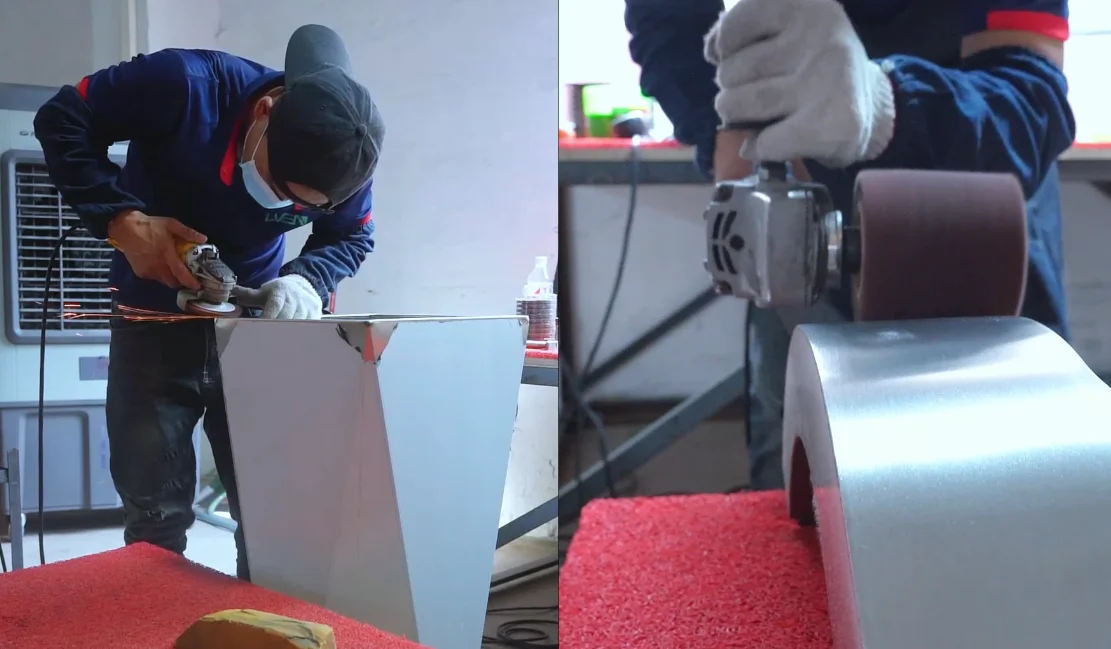
Capacity is one of the most important decisions when choosing outdoor trash cans. Too small, and the bin overflows before the next collection. Too large, and the bin may take up too much space, become difficult to move, or encourage delayed cleaning.
There is no single best capacity for every project. The right choice depends on foot traffic, waste type, collection frequency, and available space.
Application Area | Suggested Capacity Range | Suitable Bin Type | Buyer’s Notes |
Small garden or quiet walkway | 25–40L | Single bin or compact metal bin | Good for low-traffic areas |
Park path or scenic rest area | 40–60L | Covered outdoor bin or park trash can | Balance capacity and visual design |
Commercial street or plaza | 60–100L | Commercial outdoor trash cans | Better for food packaging and drink waste |
Tourist area or event space | 80–120L+ | Large-capacity outdoor trash receptacles | Needs frequent collection planning |
Recycling area | 2×40L, 3×40L, or customized | Multi-compartment recycling receptacles | Use clear labels and color coding |
Municipal project | Project-based | Standardized public waste bin series | Consider unified design and easy replacement |
For high-traffic spaces, buyers should not only increase bin capacity. They should also improve placement density and collection frequency. A 120L bin may still overflow if it is placed in the wrong location or serviced too rarely. In contrast, several well-placed medium-capacity bins may perform better and look cleaner.
The U.S. EPA notes that commercial and institutional buildings such as schools, stores, hotels, restaurants, and offices generate significant waste, and effective waste management can help reduce cost and improve sustainability. This is especially relevant for commercial areas where waste volume is closely linked to visitor behavior, tenant type, and maintenance planning.
For a more detailed sizing method, see LVEN’s Outdoor Trash Bin Capacity Guide for Public Projects.
What Material is Best for Outdoor Trash Bins?
The best material for an outdoor trash bin depends on climate, budget, appearance, maintenance expectations, and project type. Buyers should evaluate material from a life-cycle perspective, not just initial cost.
Material | Best For | Advantages | Points to Check |
Galvanized steel | Municipal areas, parks, commercial projects | Strong, cost-effective, widely used | Coating quality, sheet thickness, welding points |
Stainless steel 304 | Humid areas, premium commercial spaces | Better corrosion resistance, clean appearance | Surface finish, fingerprint resistance, cost |
Stainless steel 316 | Coastal, high-humidity, or harsh environments | Stronger corrosion resistance | Higher cost, suitable for demanding sites |
Aluminum | Modern commercial areas, planters, lightweight bins | Rust-resistant, lighter weight | Thickness and structural reinforcement |
Steel + PS plastic wood | Parks, scenic areas, commercial spaces | Warmer appearance, lower wood maintenance | UV resistance, color stability, fixing method |
Painted steel | Budget-sensitive public projects | Flexible color and design options | Outdoor powder quality and pre-treatment |
Plastic | Lightweight outdoor use | Lower cost, easy to move | Less premium appearance, lower impact resistance |
For most public projects, galvanized steel with outdoor powder coating is a practical option when budget and durability need to be balanced. Stainless steel is better for higher-end or more corrosive environments. Aluminum can work well for modern spaces, while steel plus plastic wood is often suitable for parks and landscape areas.
Buyers should ask for more than a material name. They should confirm thickness, surface treatment, welding quality, powder coating type, drainage design, inner liner material, and whether the material is suitable for the local climate.
Recycling Receptacles: When Do You Need Sorting Bins?
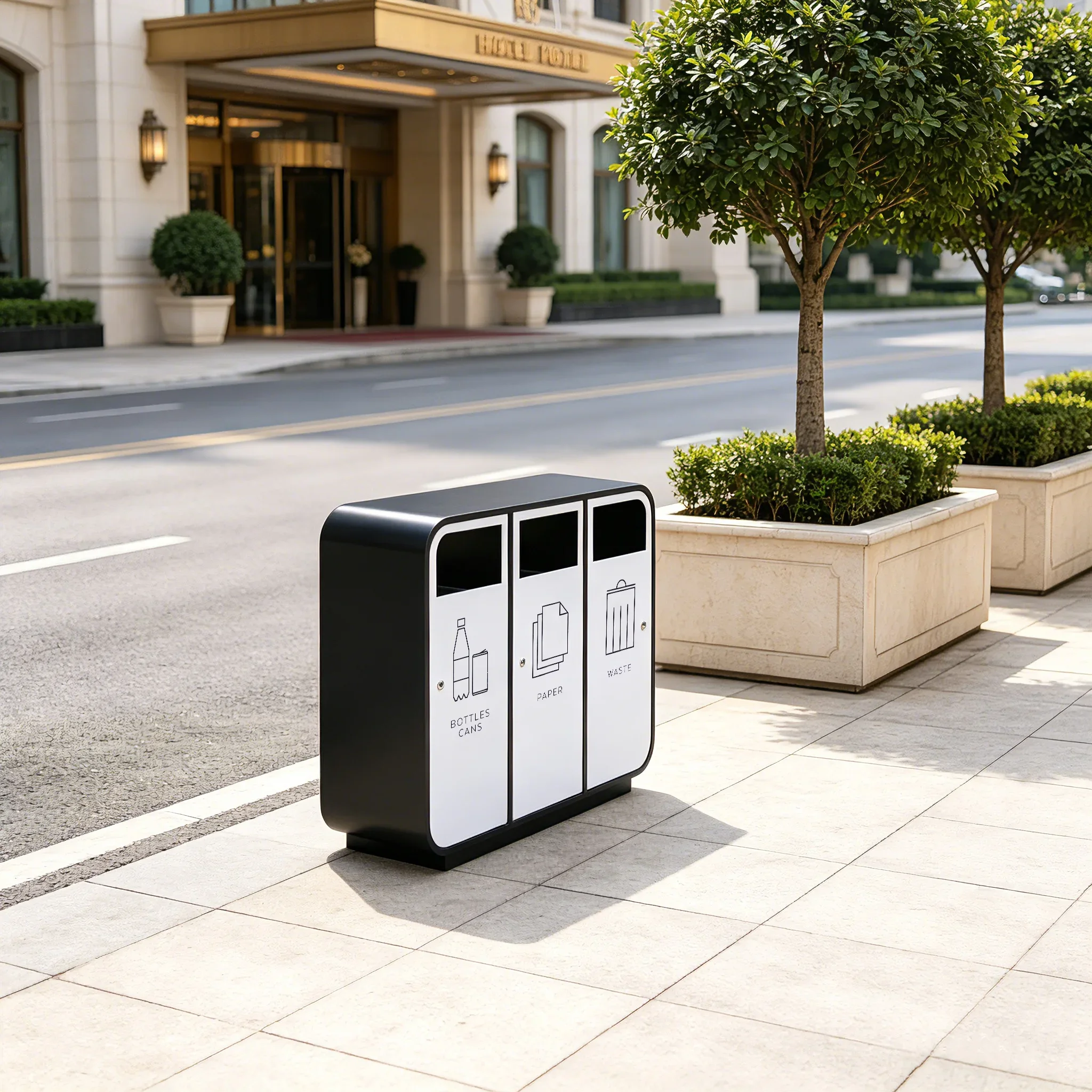
Recycling receptacles are useful when a public space has enough recyclable waste and users can clearly understand how to separate it. Common applications include schools, commercial buildings, campuses, parks, transport stations, and shopping centers.
A recycling bin system may include:
① General waste
② Recyclables
③ Paper
④ Plastic bottles and cans
⑤ Food waste
⑥ Glass
⑦ Cigarette waste
⑧ Pet waste
However, more compartments do not always mean better recycling. If labels are unclear or categories are too complicated, users may put waste in the wrong opening. That increases contamination and reduces the value of collected recyclables.
The EPA explains that recycling involves collecting and processing materials that would otherwise be discarded, while also emphasizing the waste management hierarchy, where reduction and reuse are prioritized before recycling. For buyers, this means recycling bins should be part of a wider waste strategy, not just a decorative symbol of sustainability.
A good recycling receptacle should have:
① Clear color coding
② Simple, large labels
③ Different opening shapes when useful
④ Easy-access inner buckets
⑤ Matching capacity between compartments
⑥ Weather-resistant label panels
⑦ A structure that prevents users from mixing waste too easily
For outdoor areas, labels should remain readable after sunlight, rain, cleaning, and long-term use. In commercial and school projects, pictorial labels may perform better than text-only instructions because users may include children, tourists, or people speaking different languages.
Lid, Opening and Inner Bucket Design for Outdoor Trash Receptacles
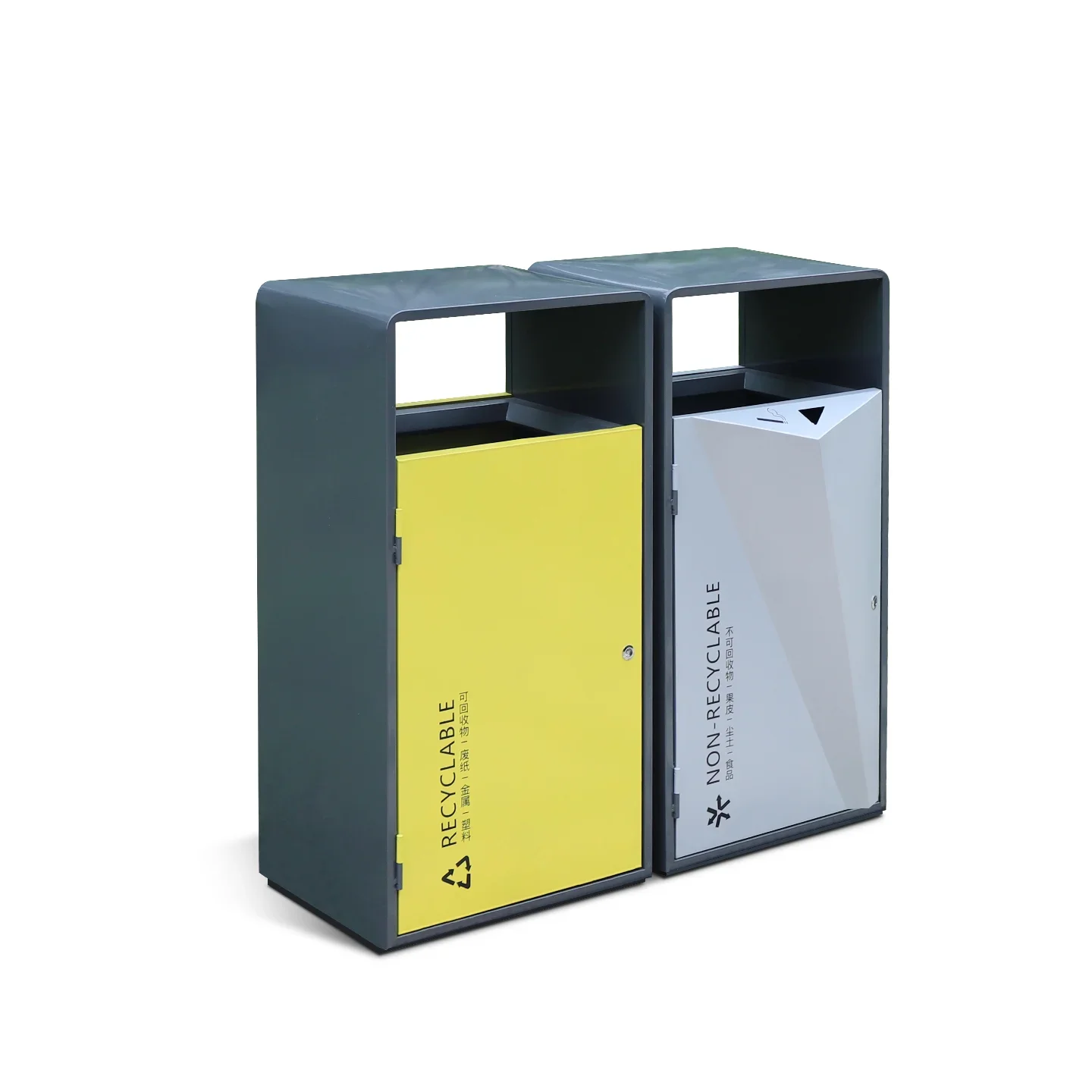
The lid and opening design directly affects user behavior, rain protection, odor control, and cleaning efficiency.
Open Top vs. Covered Top
Open-top bins are easy to use, but they allow rainwater, leaves, and birds to enter more easily. Covered-top bins are better for outdoor environments because they help reduce rainwater entry and keep the bin cleaner. For streets and parks, a covered or partially covered opening is usually more practical.
Side Opening vs. Top Opening
Top openings are simple and visible. Side openings can help reduce rain entry and may create a cleaner appearance. For commercial outdoor trash cans, side openings often look more refined and can be integrated into modern rectangular designs.
Inner Bucket or Bag Holder
For project use, an inner bucket is usually better than placing a garbage bag directly inside the outer shell. Inner buckets make cleaning easier, protect the outer structure, and reduce leakage. Buyers should check whether the inner liner is galvanized steel, stainless steel, or powder-coated metal.
Lock, Door and Access Design
Outdoor bins in public spaces often need lockable doors or secure access panels. This helps prevent tampering and keeps the structure stable. At the same time, maintenance teams should be able to open and empty the bin quickly.
A good design balances public security with daily service efficiency. Compare rain hoods, side openings and open-top structures in LVEN’s Outdoor Trash Can Lid Types guide.
Installation Methods for Park Trash Cans and Street Bins
Installation affects safety, theft prevention, cleaning convenience, and future replacement.
Installation Method | Suitable Scenario | Advantages | Notes |
Freestanding | Parks, plazas, flexible commercial areas | Easy to move and adjust | May need heavier base for stability |
Surface mounted | Streets, sidewalks, municipal areas | Stable and anti-theft | Requires drilling and fixed location |
Embedded installation | Long-term municipal projects | Strong stability | Harder to relocate |
Wall mounted | Narrow spaces, entrances, corridors | Saves floor space | Limited capacity |
Modular grouped installation | Recycling zones, campuses, commercial areas | Supports sorting and unified management | Needs careful layout planning |
For street projects, fixed installation is usually preferred because bins need to stay in place and resist movement. For commercial areas, freestanding bins may be useful when layout changes are common. For parks and scenic areas, the choice depends on terrain, visitor flow, maintenance routes, and landscape design.
For mounting details, review the guide on how to secure outdoor trash cans with surface mounts, anchors and in-ground options.
Corrosion Resistance and Outdoor Durability for Public Waste Bins
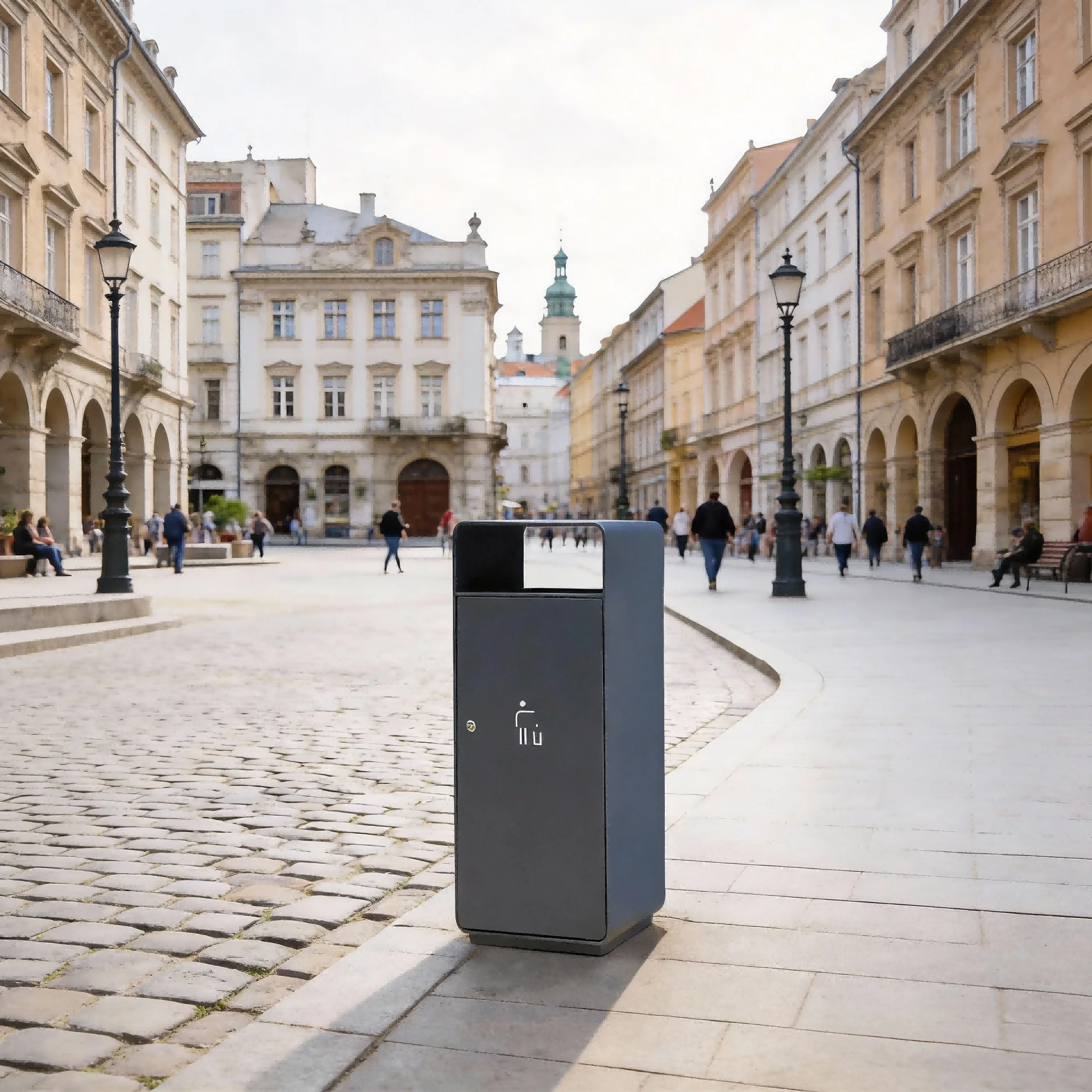
Outdoor bins face a tough environment. Rain, humidity, UV exposure, cleaning chemicals, coastal air, dust, temperature changes, and daily impact can all shorten product life.
To improve durability, buyers should pay attention to:
① Material grade
② Steel thickness
③ Welding quality
④ Surface pre-treatment
⑤ Powder coating quality
⑥ Drainage design
⑦ Anti-rust treatment on edges and joints
⑧ Replaceable parts
⑨ Bottom structure and ground contact points
For coastal or high-humidity environments, stainless steel 304 or 316 can be considered if the budget allows. For standard municipal and commercial areas, galvanized steel with proper outdoor powder coating is often a cost-effective choice.
The most common mistake is focusing only on the visible surface. Rust often begins at welds, edges, holes, hinges, bottoms, and damaged coating areas. This is why manufacturing process and quality control matter as much as material selection.
Maintenance Cost: The Hidden Factor in Outdoor Trash Bin Selection
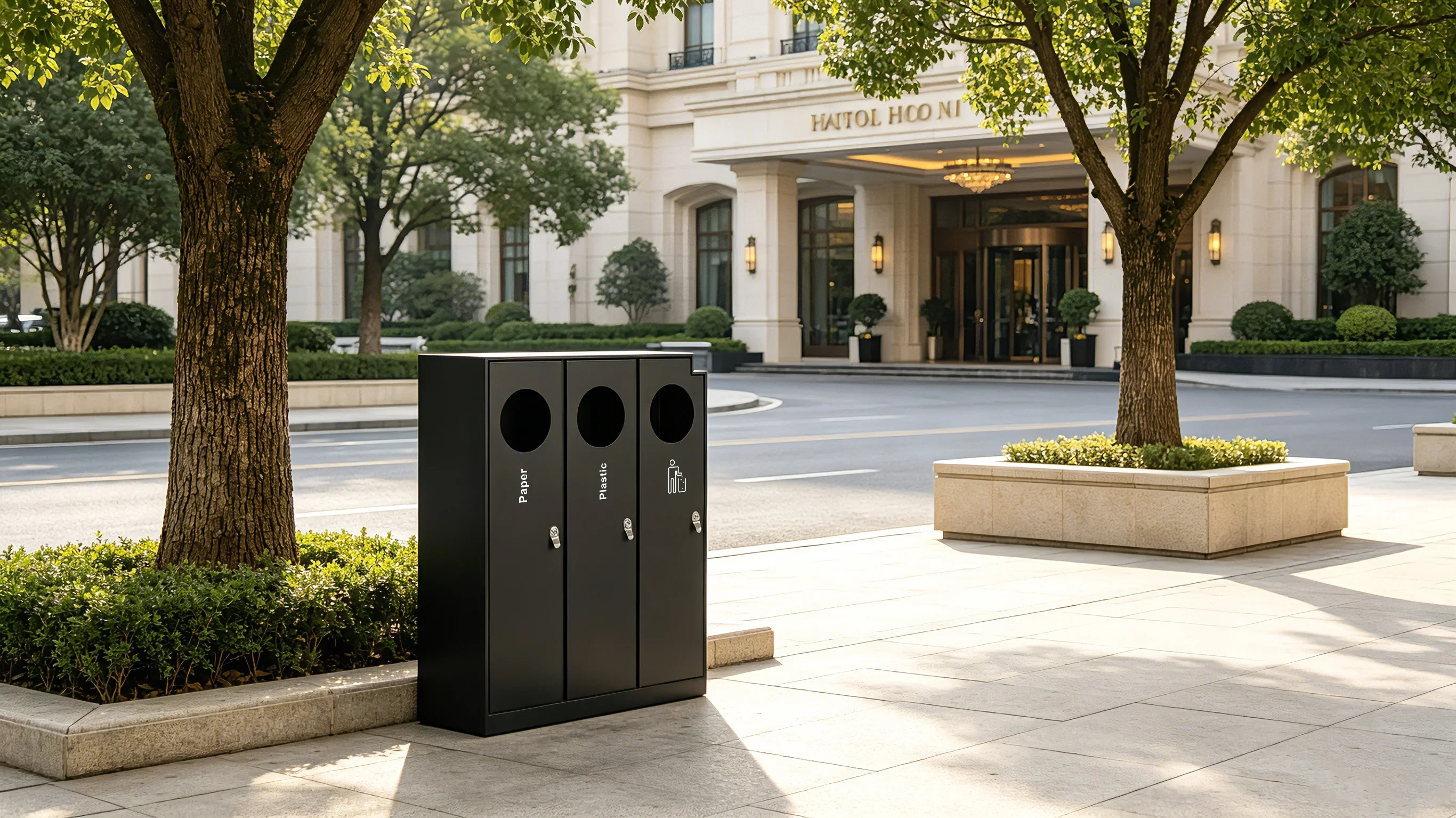
The purchase price is only part of the total cost. For public projects, the real cost includes installation, cleaning time, liner replacement, coating repair, spare parts, complaint handling, and possible early replacement.
A lower-cost bin may become expensive if it:
① Rusts quickly
② Overflows often
③ Is difficult to clean
④ Has weak hinges or locks
⑤ Allows rainwater to collect inside
⑥ Does not match collection routes
⑦ Requires frequent repainting or replacement
⑧ Has no spare parts support
A better outdoor trash bin should reduce the workload of maintenance teams. This means the door should open smoothly, the inner bucket should be easy to remove, the structure should be stable, and the surface should be simple to clean.
For commercial properties, a cleaner waste area also improves visitor perception. For municipal buyers, easier maintenance can reduce long-term operating pressure. For distributors, reliable products reduce after-sales problems and improve repeat orders.
Outdoor Trash Bin Procurement Checklist for Project Buyers
Use this checklist before confirming specifications or requesting a quotation.
Buying Item | What to Confirm | Why It Matters |
Application | Park, street, commercial area, school, hotel, scenic area, municipal project | Determines style, capacity, and durability needs |
Waste type | General waste, recyclables, food packaging, pet waste, cigarette waste | Helps choose openings and compartments |
Capacity | 25L, 40L, 60L, 80L, 100L, 120L, or custom size | Prevents overflow and oversized placement |
Material | Galvanized steel, stainless steel, aluminum, steel + plastic wood | Affects durability, appearance, and cost |
Surface treatment | Outdoor powder coating, wood grain finish, stainless finish | Affects anti-corrosion and visual consistency |
Inner liner | Galvanized, stainless steel, powder-coated bucket, bag holder | Affects cleaning and long-term maintenance |
Lid design | Open top, covered top, side opening, rainproof design | Affects usability and weather protection |
Installation | Freestanding, surface mounted, embedded, wall mounted | Affects safety and project layout |
Recycling function | Single stream, dual stream, multi-compartment | Affects sorting and waste management |
Customization | Color, logo, size, structure, label, packaging | Helps match project and brand needs |
Maintenance | Lock, hinge, door, liner access, spare parts | Reduces long-term service cost |
Delivery | Sample, lead time, bulk production, export packing | Controls project schedule |
Supplier capability | Design support, QC, OEM/ODM, after-sales | Reduces sourcing risk |
A good procurement decision should not stop at “which model is cheaper?” It should answer: which product will keep the space cleaner, last longer, reduce maintenance work, and match the project’s visual system?
How LVEN Supports Outdoor Trash Bin Projects?

LVEN provides outdoor trash bins as part of its urban furniture product series, alongside recycling bins, single bins, dog trash bins, ashtrays, park benches, planters, picnic tables, tree benches, and bicycle racks. Its outdoor trash bin page highlights multiple outdoor trash can types and supports product configuration and customization according to different scenarios.
For project buyers, this matters because trash bins are rarely purchased alone. A park, municipal street, commercial plaza, or scenic area may also need benches, planters, ashtrays, bicycle racks, and other site furnishings. Working with one supplier can help keep materials, colors, dimensions, and overall design style more consistent.
Outdoor Trash Bin Options for Different Project Needs
LVEN supports different outdoor trash can styles for parks, streets, commercial areas, and public facilities. Buyers can choose from standard models or request custom adjustments for size, capacity, color, opening design, logo, material, and surface finish.
Material and Corrosion Protection Support
According to LVEN’s outdoor trash bin page, for coastal or harsh environments, 304 or 316 stainless steel can be selected if the budget allows. For tighter budgets, galvanized sheet or stainless steel with zinc-rich primer and weather-resistant powder coating can help extend service life. LVEN also offers outdoor powder options and color customization for project needs.
Customization for Project and Distributor Orders
LVEN supports custom outdoor trash bins based on drawings, images, project requirements, or brand needs. This is useful for distributors, contractors, municipal buyers, and commercial developers who need product consistency across multiple sites.
One-Stop Public Space Furniture Matching
Because LVEN also supplies benches, planters, bike racks, picnic tables, ashtrays, and other urban furniture, buyers can build a more coordinated public space furniture package instead of sourcing each product category separately.
FAQ About Outdoor Trash Cans
How do I choose outdoor trash bins for a public space?
Start with the application scenario, foot traffic, waste type, capacity requirement, collection frequency, material, installation method, and maintenance plan. Parks may need landscape-friendly bins, streets need space-efficient and durable bins, while commercial areas often need a stronger balance of appearance, capacity, and easy cleaning.
What material is best for outdoor trash bins?
Galvanized steel is practical for many municipal and commercial projects because it balances strength and cost. Stainless steel 304 or 316 is better for humid, coastal, or premium environments. Aluminum is lighter and rust-resistant, while steel combined with plastic wood can create a warmer appearance for parks and scenic areas.
What size outdoor trash can do I need?
Small gardens and low-traffic areas may use 25–40L bins. Parks and scenic areas often use 40–60L bins. Commercial streets and plazas may need 60–100L bins. Tourist areas, event spaces, or high-traffic public zones may require 80–120L or larger capacity, depending on collection frequency.
Are recycling receptacles necessary for parks and commercial areas?
Recycling receptacles are useful when the site generates enough recyclable waste and users can easily understand the sorting rules. They are especially suitable for schools, campuses, commercial buildings, transport spaces, and public areas with sustainability goals. Clear labels and simple categories are important to reduce contamination.
Should outdoor trash bins be fixed to the ground?
For streets, sidewalks, municipal areas, and high-traffic public spaces, surface-mounted or embedded installation is often recommended for stability and theft prevention. For parks or commercial plazas, freestanding bins may be suitable if layout flexibility is needed.
How can outdoor trash cans reduce maintenance cost?
Choose bins with durable materials, proper outdoor coating, easy-access inner liners, stable hinges, lockable doors, rain-resistant openings, and replaceable parts. A well-designed bin can reduce cleaning time, repair frequency, rust problems, and early replacement costs.
Can commercial outdoor trash cans be customized?
Yes. Project-grade commercial outdoor trash cans can often be customized in capacity, material, color, surface finish, logo, opening type, liner design, installation method, and packaging. For large projects, buyers should confirm drawings, samples, production time, and quality control requirements before bulk orders.
Conclusion
Choosing the right outdoor trash bins for parks, streets, and commercial areas requires more than selecting a product from a catalog. Buyers need to consider where the bin will be used, how much waste it will collect, how often it will be emptied, what materials can survive the environment, and how the design affects maintenance and public behavior.
For parks, the priority is visitor convenience, landscape fit, and easy cleaning. For streets, durability, placement, and pedestrian access matter more. For commercial areas, the bin should combine function, capacity, appearance, and brand consistency.
A well-selected outdoor trash bin can help keep public spaces cleaner, reduce long-term maintenance costs, support recycling goals, and improve the overall image of a project.
LVEN supports outdoor trash bin projects with standard models, customized designs, material guidance, corrosion-resistant options, OEM/ODM service, bulk production, and coordinated public space furniture solutions.
Contents


