Separate Bins or One Multi-Compartment Recycling Station?
 19
 Share
Choose separate bins when the site needs independent capacity, phased expansion or the ability to replace one unit without disturbing the others. Choose a multi-compartment recycling station when a defined collection point, coordinated openings and a fixed layout suit the location. Either arrangement can support waste separation; performance depends on the streams provided, clear instructions and a collection process that keeps those streams separate.
For project buyers, the comparison is about how to house the same collection programme. Two independent receptacles and one two-compartment cabinet may offer similar choices to the public while creating different installation and maintenance tasks. Decide what the site needs before comparing the number of products on a quotation.
Separate Bins vs a Multi-Compartment Recycling Bin: Start with the Same Streams
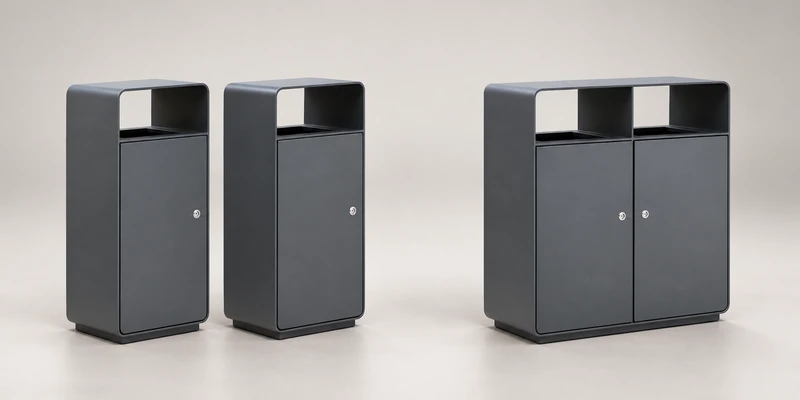
AI-generated layout illustration based on product references; capacities differ and dimensions require confirmation.
First agree which materials the collection service accepts and how they must be separated. For example, a site collecting general waste and mixed recyclables needs both options at the disposal point, whether they sit in separate bodies or separate compartments. Adding extra openings without a corresponding collection route can create a sorting task that the operator cannot maintain.
The phrase single bin describes an individual receptacle in this comparison. It does not mean single-stream recycling, which describes a collection system for commingled recyclables. Likewise, a multi-compartment body does not tell you whether the contents will remain separate after collection. Confirm the route from the public opening to the liner, collection cart, storage area and final collection service.
Compare capacity by waste stream, not only by total litres. Unused space in one compartment cannot normally absorb overflow from another while preserving separation. A cabinet with equal compartments may be unsuitable where one stream consistently fills first. Separate bins can allow different sizes, but a purpose-designed cabinet may also provide unequal compartments; check the actual configuration rather than assuming either format has exclusive flexibility.
This gives a fair basis for evaluating separate bins vs a multi-compartment recycling bin: the same accepted materials, the same expected collection interval and a realistic capacity allocation. If one proposal uses larger liners or an extra waste stream, identify that difference before interpreting its price or footprint.
When Are Individual Bins for Recycling More Practical?
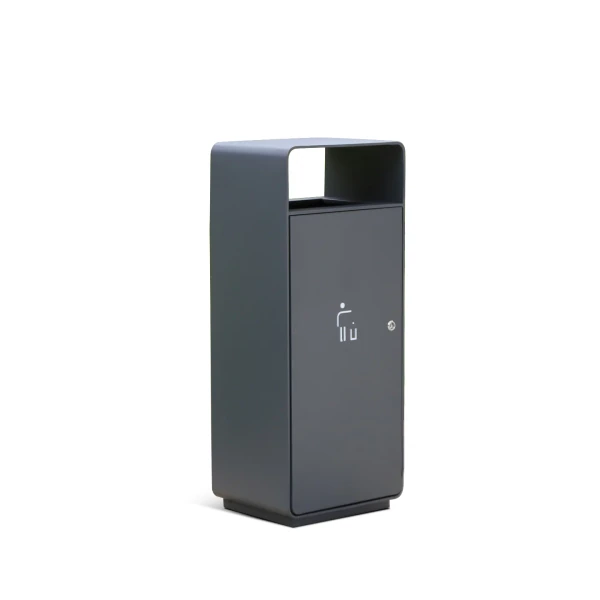
Individual bins for recycling are useful where demand changes by season, tenant mix or operating phase. A property opening one section at a time may add matching receptacles as activity increases. A park with a busy refreshment area and a quieter entrance may need different capacity allocations while retaining a consistent appearance and label system.
Separate bodies also allow localised replacement. If one enclosure is damaged, it can potentially be replaced without removing an entire station. That benefit depends on the fixings and layout: a unit attached to a shared frame is less independent than it appears. Confirm whether each bin can be unfastened, handled and returned to service without dismantling neighbouring equipment.
The trade-off is the need to manage the group as one public disposal point. Loose positioning can leave the general-waste bin beside the main path and the recycling bin partly hidden behind it. Movement by cleaning teams or unauthorised users can widen the separation further. Establish a defined location and an appropriate fixing arrangement instead of relying on a photograph of an orderly row at handover.
Maintenance access between individual bodies also needs consideration. Narrow gaps collect litter and can be difficult to sweep. Larger gaps improve access but increase the overall width and may weaken the visual relationship between streams. Separate bins are a strong choice when their independence solves an operating need and the grouped layout can be maintained consistently.
When Does One Multi-Compartment Recycling Bin Make Sense?
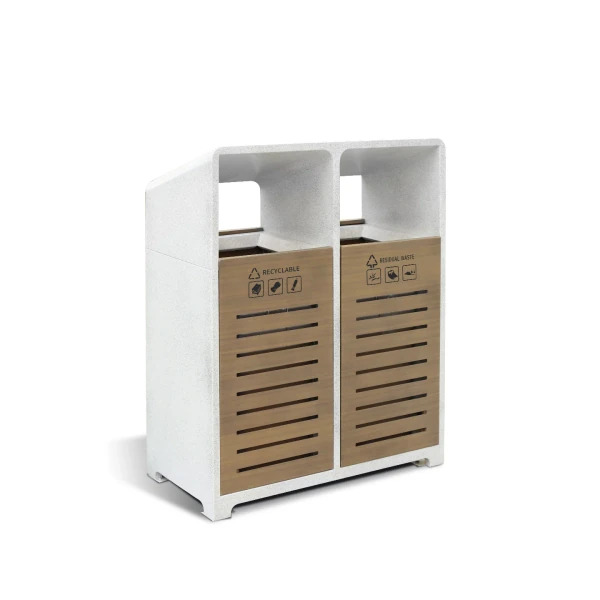
A multi compartment recycling bin can create a clear destination at an entrance, plaza or other established collection point. Its openings remain in a defined relationship, and a coordinated body can simplify the visual arrangement of labels and colours. This is useful where the permanent site plan already provides enough space for the chosen waste streams and servicing movements.
Check the internal separation as carefully as the exterior. Each opening should direct material into the intended liner or compartment. Examine the areas between liners, where an item dropped at an angle could miss the container. A shared outer body does not guarantee effective separation, and a recycling symbol on the front does not demonstrate how waste moves inside it.
Consider the effect of a failure. A damaged shared hood, frame or main door may interrupt several streams, whereas a replaceable label or individual liner may affect only one. Ask which components are shared and which can be changed separately. Do not assume that a cabinet must be discarded after one compartment is damaged, or that every part is independently serviceable.
A station can keep the available choices together, but it cannot guarantee lower contamination. People still need to recognise the correct opening, and staff need to preserve the separation during emptying. Review a sample with representative waste items and the collection crew. Judge the cabinet by what users and staff can do with it, rather than by the number of apertures alone.
How Should a Recycling Station Be Measured and Serviced?
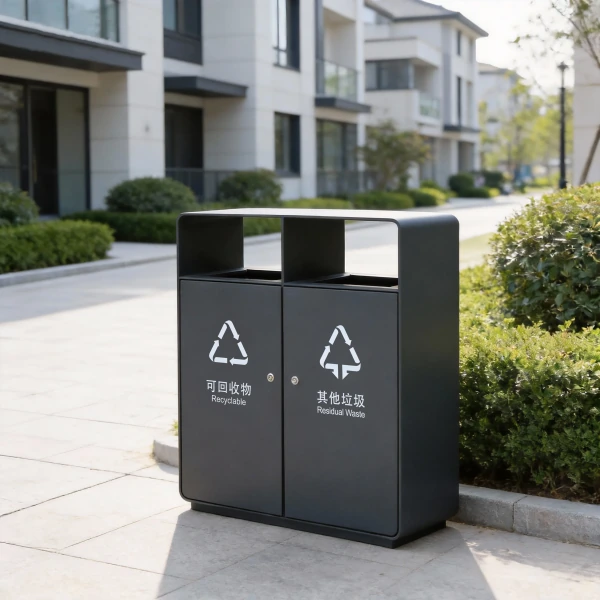
Measure the complete recycling station, including the space between separate bins, any common base, projecting signs and the maximum external depth. Then add the working area needed to open doors, remove liners and position a cart. A cabinet with a smaller closed footprint can still require more room during collection than a row of shallow individual bins.
For two separate receptacles, the overall width is the sum of their external widths plus the specified gap and any projecting fittings. For a cabinet, use its complete external dimensions. Keep the required pedestrian route outside the equipment and working areas according to the project layout and applicable local requirements. Do not interpret an unused strip on a plan as proof of an acceptable access route.
Test the actual collection sequence. Can staff empty the busiest stream without opening or handling the others? Where does the liner stand while the bag is changed? Can the crew reach the back and base for cleaning? A front-access design may suit a wall-side location, but hinges, opening angle and liner withdrawal still need checking. Compare tasks and movements, rather than assuming one body means one service action.
Before extending a layout across the site, trial it through representative busy and quiet periods. Record fullness by stream before collection, recurring sorting errors and the time needed for servicing. Keep the label system and collection interval consistent where possible, so a change in those factors is not mistaken for an effect of the cabinet format. Busch Systems' discussion of effective waste stations also emphasises evaluating performance beyond appearance. Use the trial to identify whether the limiting factor is capacity, positioning, instructions or service access before selecting more equipment.
| Project condition | Separate bins deserve consideration | One multi-compartment station deserves consideration |
|---|---|---|
| Demand differs substantially by stream | Individual sizes may support the required allocation | Check whether suitable unequal compartments are available |
| The programme will expand in phases | Add units if matching products and site space remain available | Confirm how extra streams could be accommodated later |
| A permanent, clearly defined collection point is needed | Fix the group in a consistent, visible arrangement | A shared body maintains the relationship between openings |
| Damage to one stream must cause minimal disruption | Check independent removal and replacement | Check which parts are shared and separately replaceable |
| Servicing space is restricted | Include gaps, door swings and liner movement | Include every required door and liner movement |
Can a Modular Recycling Station Adapt to Future Changes?
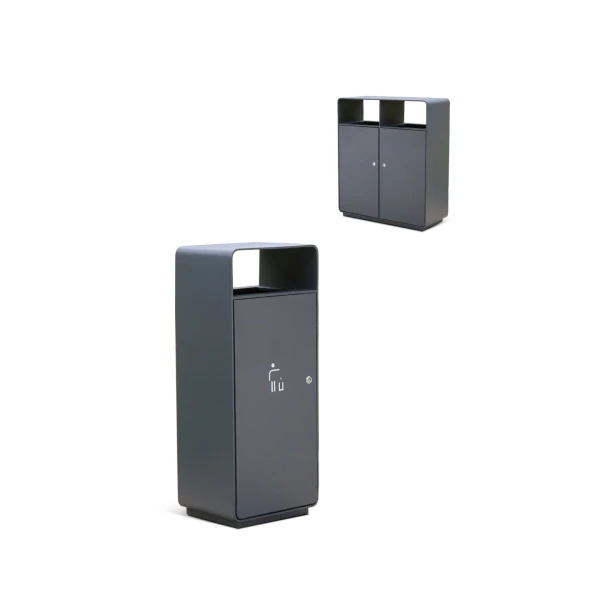
Example configurations; connectors and later reconfiguration must be confirmed for the selected product.
The word modular recycling station should describe a confirmed capability. Ask what can actually change: the number of bodies, their arrangement, the openings, labels, liners or capacity split. A supplier offering several factory configurations is different from a system that can be reconfigured after installation. Both can be useful, but they support different purchasing decisions.
For example, Glaro's RecyclePro connected stations use individual receptacles with specified connector hardware. Busch Systems' Evolve range also describes adding, removing and rearranging streams within its system. These are product-specific design approaches, not features that can be assumed for every row of bins or every multi-compartment cabinet.
For an outdoor project, confirm whether the proposed connectors, signs, finishes and fixing arrangement suit the actual exposure and installation. Do not transfer an indoor station configuration to an exposed landscape simply because its appearance fits. If future expansion matters, request the compatible components and revised layout at quotation stage, including the space needed for an additional unit.
Changing a label is the simplest form of adaptation, but it may not be enough. A new stream could need a different opening, liner, cleaning method or collection frequency. Keep the downstream collection service involved. Where future requirements are uncertain, favour a layout with a documented adaptation path rather than paying for an undefined promise of flexibility.
How Do LVEN Single Bin and Paired Options Compare?
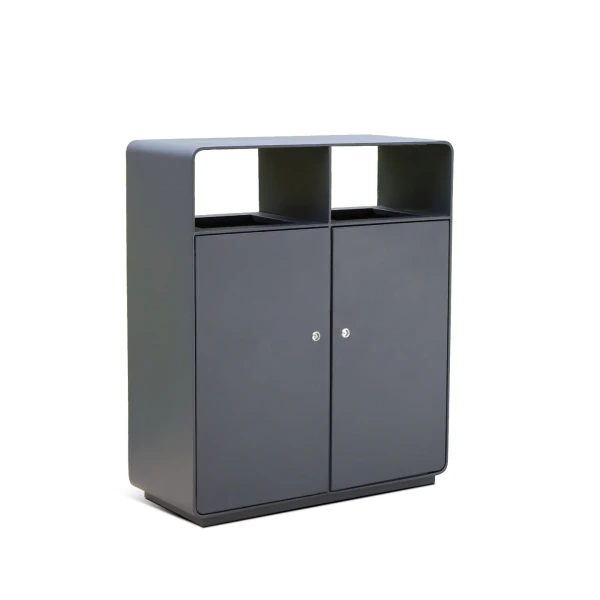
LVEN's OTB-04 product page lists a 55-litre single unit and a paired 60 L × 2 sorting layout. They are different configurations. Two 55-litre singles provide 110 litres in total; the paired option provides 120 litres across two 60-litre containers. They should not be presented as an equal-capacity comparison or as proof that all paired stations save a particular amount of space.
| Published OTB-04 configuration | Capacity | External dimensions, L × W × H |
|---|---|---|
| One single unit | 55 L | 40 × 30 × 95 cm |
| Paired sorting unit | 60 L × 2 | 78 × 35 × 95 cm |
For an illustrative wall-side plan, two singles placed with their 40 cm sides along the wall occupy 80 cm plus the specified gap. The paired unit has a stated length of 78 cm, but its stated depth is 35 cm rather than 30 cm. Add the actual installation and servicing clearances to both proposals. The small difference in closed width alone is not enough to decide which arrangement fits the site better.
The published construction includes powder-coated galvanized steel, covered openings, lockable front access and removable metal inner liners. Confirm the required labels, capacity allocation, door operation and fixing details for the selected configuration. If independent replacement, connector hardware or later conversion is essential, request those details explicitly; selecting a paired appearance does not establish a site-reconfigurable system.
Compare LVEN's single-bin range and recycling-bin range using the agreed streams, available dimensions and service method. Send the marked-up layout, expected quantities and collection requirements through the project contact page. A useful quotation should identify the configuration and what is included, so the project team can assess both the equipment and the installation work.
FAQ About Separate Bins and Multi-Compartment Recycling Stations
Do separate recycling bins take up more space than one station?
Sometimes, but compare actual dimensions. Separate bins require an allowance for gaps and fittings; a cabinet may be deeper or need a larger door-opening area. Measure the complete installed group and the collection movements, not just the closed bodies.
Does a multi-compartment recycling bin reduce contamination?
It can keep the waste choices together, but the body format alone does not guarantee an improvement. Accepted materials, opening design, labels and collection procedures all matter. Check that each opening feeds the intended container and that staff retain separation after emptying.
Can a separate single bin become part of a recycling station later?
Potentially, if the new arrangement provides the required stream, suitable labels and compatible positioning or fixings. Physical connection and interchangeable parts must be verified for the product. Standing two bins beside each other does not make them a manufacturer-designed modular system.
Contents