Planning Waste and Recycling Bins for Fuel Forecourts
 69
 Share
Plan fuel-forecourt bins around where customers discard items, the materials accepted by the waste collector and the route staff use to empty each point. Assess fuel islands, store approaches and other customer areas separately, with final locations checked against the operator’s site-safety requirements.
For service-station operators, contractors and procurement teams, forecourt recycling bins connect customer convenience with daily collection work. A station beside the shop may serve people leaving with refreshments but remain inconvenient for drivers clearing litter from their vehicles. Likewise, a compact cabinet may fit an island when closed yet leave insufficient room for a worker to remove its liner.
Start with the site’s disposal patterns and operating constraints. Then specify the openings, capacity, construction and service access needed at each approved location.
Where Should Forecourt Recycling Bins Be Placed?
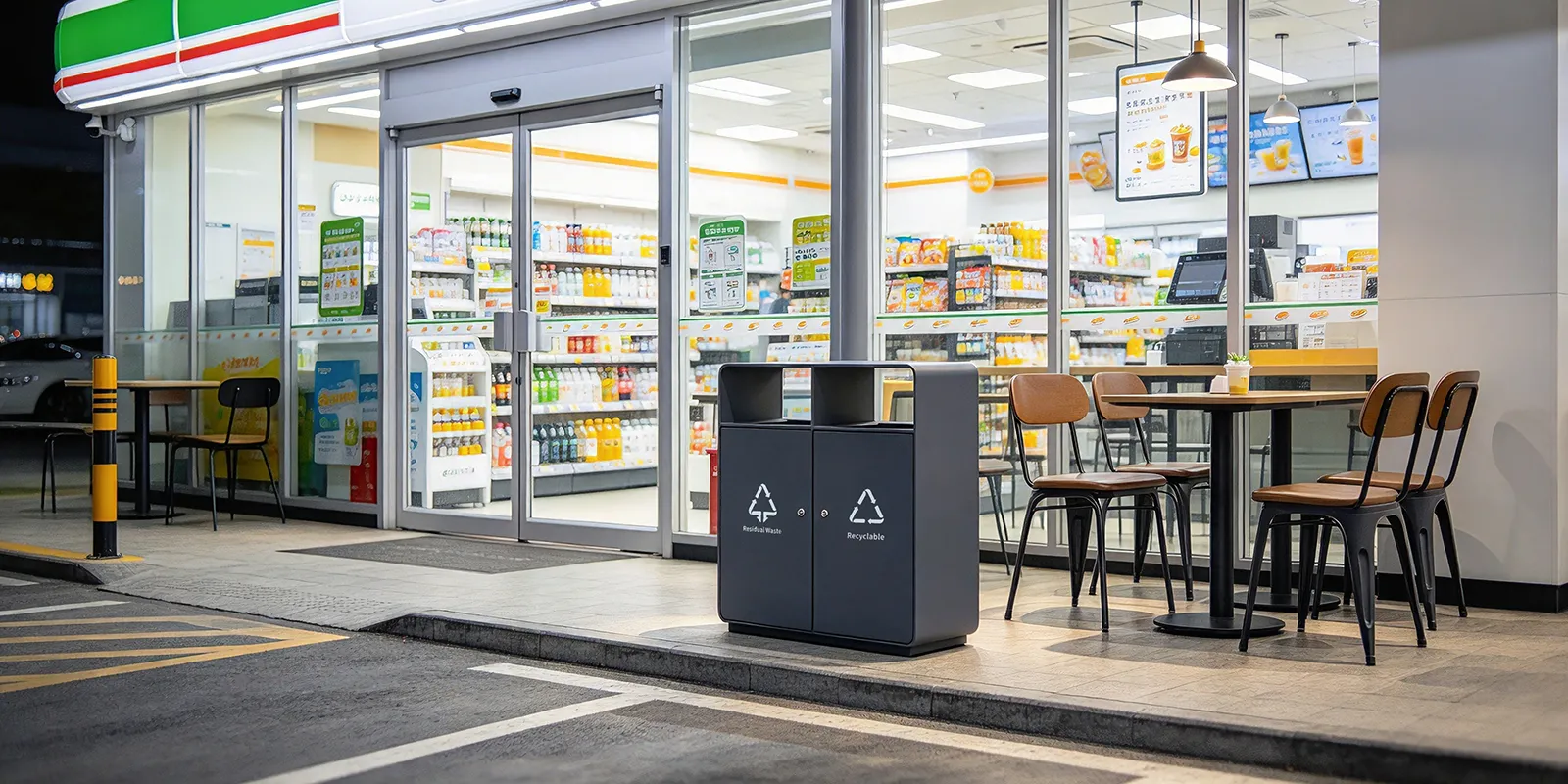
Map where customers finish with packaging or remove ordinary litter from vehicles. Include the fuel islands, convenience-store approach, refreshment areas and any car-wash or vacuum facilities. Observe these areas during normal operation and busy periods rather than selecting positions from an empty site plan.
| Site area | Waste pattern to verify | Equipment decision | Collection check |
|---|---|---|---|
| Fuel island | Packaging and drink containers discarded during a stop | Grouped disposal choices at an approved position | Staff access around stopped vehicles and fuel equipment |
| Store approach | Items carried towards or away from the shop | Visible openings outside doors and queues | Inspection around customer traffic peaks |
| Refreshment or seating area | Cups, lids and food packaging | Streams supported by the collection service | Remaining liquids, cleaning and removal after busy periods |
| Car-wash or vacuum area | Ordinary litter removed from vehicles | Capacity and openings matched to observed contents | Collection coordinated with vehicle movements |
| Service storage area | Materials consolidated from customer points | Storage compatible with contractor collection | Separation, access and handover responsibility |
Visibility should be assessed from the customer’s actual position. A public waste bin that appears obvious on a drawing may disappear behind a parked vehicle, dispenser or promotional display. Check the approach from both sides of an island and from the routes customers use between their vehicles and the shop.
A historical example illustrates why this matters. In a 2016 AASHE article, former Kum & Go sustainability manager Adam Hammes described trials in which at-pump recycling performed better than alternative locations. He also identified problems when recycling and trash were positioned on opposite sides of a pump. The useful lesson is to examine the disposal decision where it happens; those trials do not establish one layout for every station.
Treat the shop entrance as a separate collection point. Customers leaving with refreshments may generate different waste from drivers clearing their cars. Keep the proposed station visible without placing it within door movements, queues or required circulation space.
Mark candidate positions before ordering. The operator’s site review must establish which locations can accommodate the equipment and its use. Where an island cannot provide suitable space, reconsider the cabinet configuration or collection arrangement rather than filling the nearest available gap.
Which Waste Streams Should Outdoor Recycling Bins Collect?
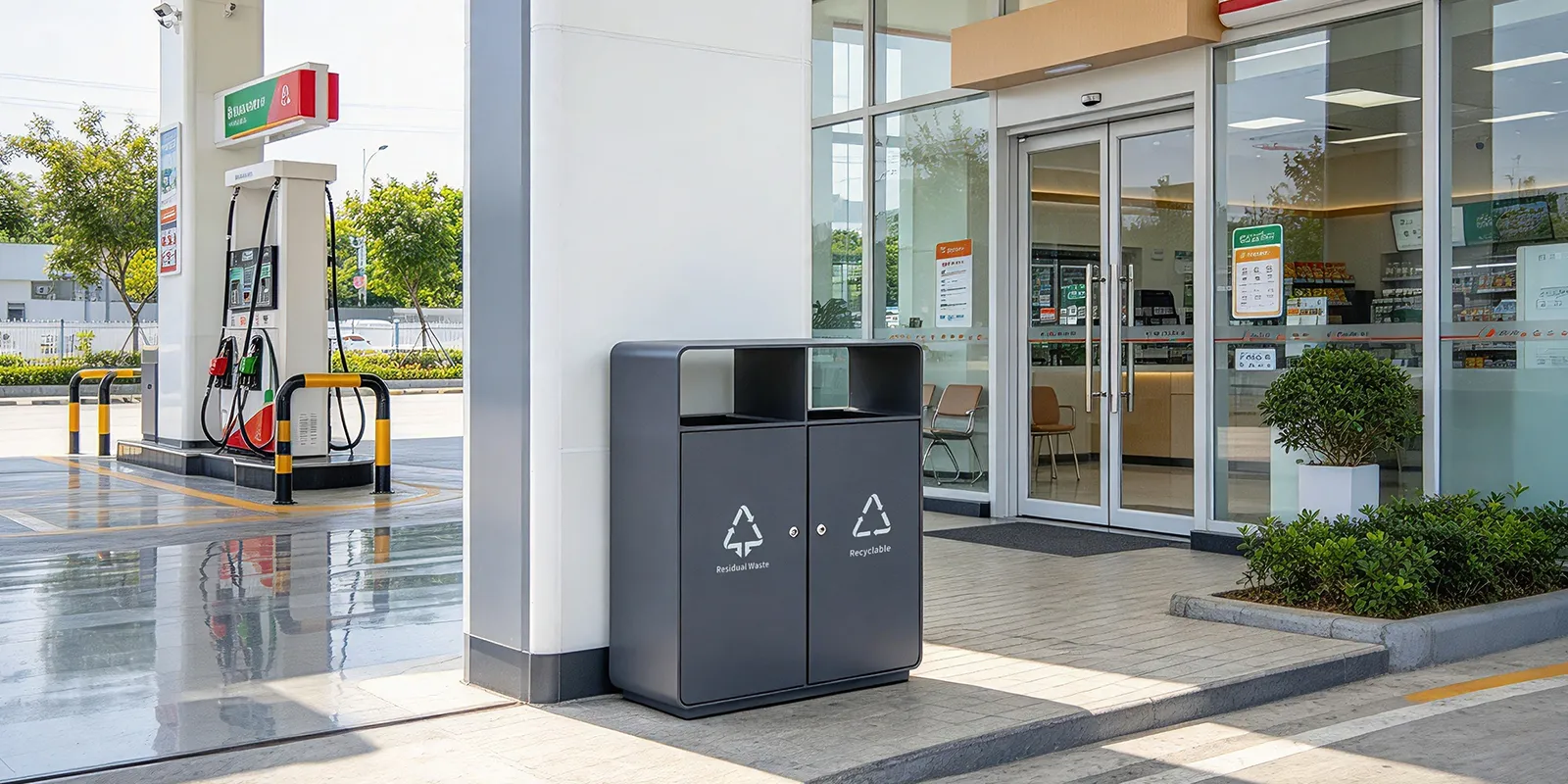
Begin with a short review of the ordinary customer waste generated at each location. Drink bottles, cans, cups, snack wrappers and food packaging may appear in different proportions across the site. Ask the collection provider which materials it accepts and whether they must remain in separate streams.
For outdoor recycling bins, labels and openings should follow that collection agreement. A recycling symbol does not make every item recoverable, and adding another compartment offers little value if no separate collection route exists for its contents.
Coffee and food-to-go packaging deserve particular attention. Confirm how the provider handles the cups, lids, cartons and food-soiled packaging actually supplied by the store. Agree how remaining drinks are managed before selecting the cabinet and cleaning routine. Customers should not be directed to empty liquids onto the forecourt or into an unapproved drain.
Keep the available choices together at the same disposal point. Someone holding a bottle and a snack wrapper should be able to identify both destinations without searching around the island. Use short material names and recognizable examples, with labels visible while approaching and while standing at the opening.
Local requirements can influence the arrangement. For example, CalRecycle’s commercial-recycling FAQ explains customer-container requirements for covered California businesses, including visibility, accessibility, marking and placement alongside trash containers. Applicability depends on the business and its collection system; confirm the requirements for the particular property.
Maintain a clear distinction between customer litter and operational waste. Fuel-contaminated absorbents, oil containers and other potentially hazardous materials belong within the operator’s designated procedures. Ordinary public collection points should not become their default disposal route.
How Should Outdoor Litter Bins Fit Forecourt Traffic Routes?
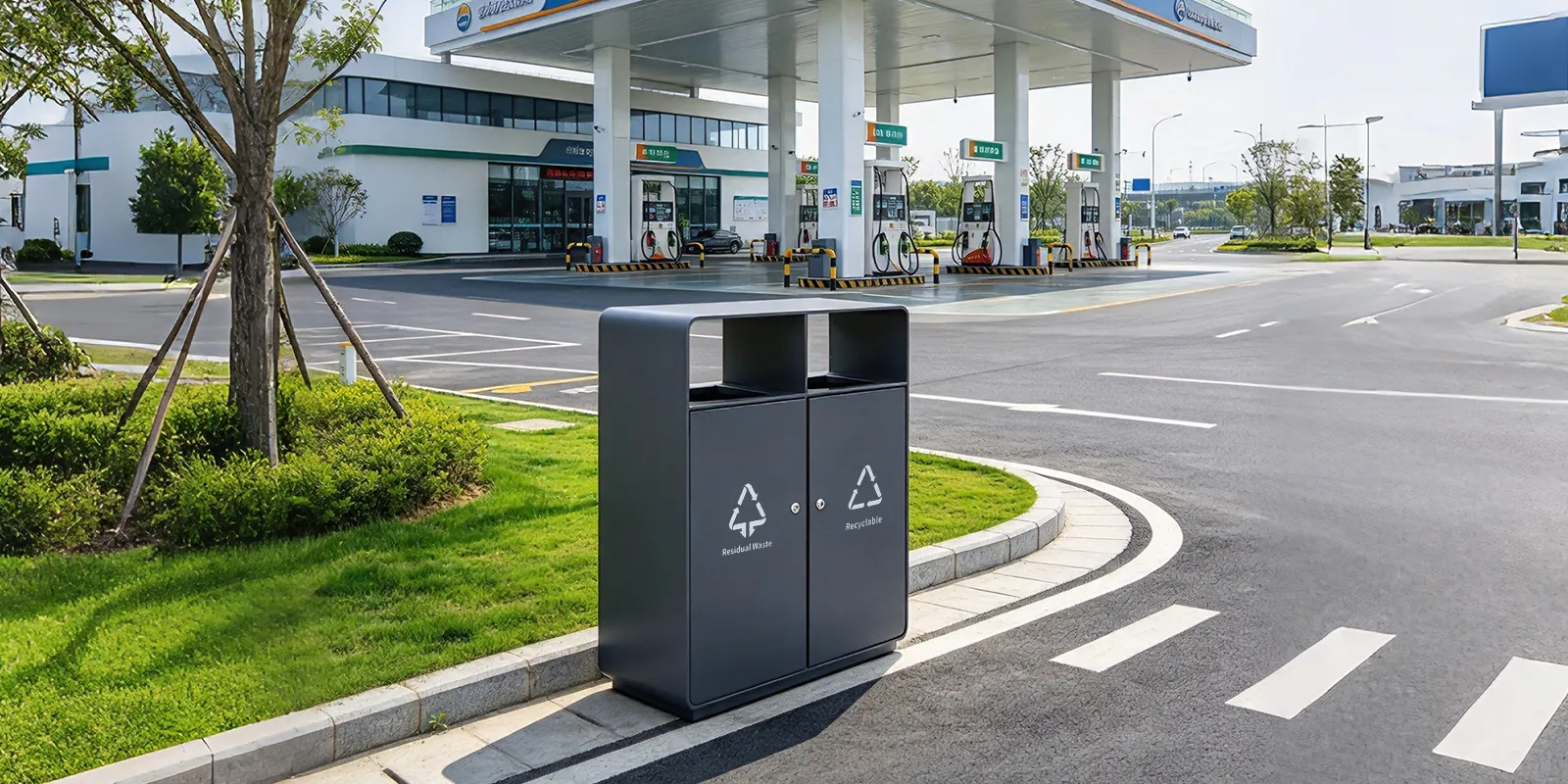
Assess outdoor litter bins with the site in use. Follow a customer approaching the opening, another person passing behind, a vehicle stopping alongside and a worker opening the service door. All four movements can occupy space beyond the cabinet’s footprint.
Include vehicle doors, delivery activity and the route between parking and the store. A pedestrian approach should remain usable during the parking positions and traffic patterns normally expected at that location. Existing barriers protecting fuel equipment should not be assumed to protect an additional cabinet.
Car-wash and vacuum areas need their own assessment. Customers may stand beside open vehicle doors while staff need access to remove collected bags. A container placed conveniently for one task can interrupt the other. Check the operating sequence before deciding which side of the area should receive the collection point.
Keep openings and service doors clear of emergency equipment, safety signs and required access. For UK projects, HSE’s petrol-filling-station guidance identifies the relevant operating framework, including dangerous-substances requirements. The operator and competent site advisers should determine the necessary siting controls. A general bin specification cannot provide a universal clearance from a dispenser.
Installation details also matter. Confirm the approved mounting method and any restrictions associated with underground services before drilling or fixing the surface. An optional ashtray from a general product catalogue should not be introduced into a fuel-area layout without the operator’s specific assessment.
If routine emptying repeatedly conflicts with traffic, resolve the collection route, timing or equipment position before purchase. Additional capacity cannot correct a point that staff cannot reach appropriately.
Choosing Commercial Outdoor Trash Cans for Forecourt Exposure
Describe the exposure at each proposed location rather than specifying simply “outdoor use.” A canopy may leave openings exposed to wind-driven rain, while a shop-side unit can receive direct sun, splash, dust and frequent cleaning.
Assess the cover, deposit opening, inner liner, finish, hinges, locks and fixing arrangement together. The construction should suit the intended location and maintenance routine. Material names alone do not establish weather performance, cleaner compatibility or a particular fire rating.
Test the opening with representative empty bottles, cups and packaging. A narrow aperture can help communicate an intended stream, but an opening that rejects common accepted items may encourage litter on top of the cabinet. Decide how larger customer rubbish will be handled instead of assuming every object should fit every opening.
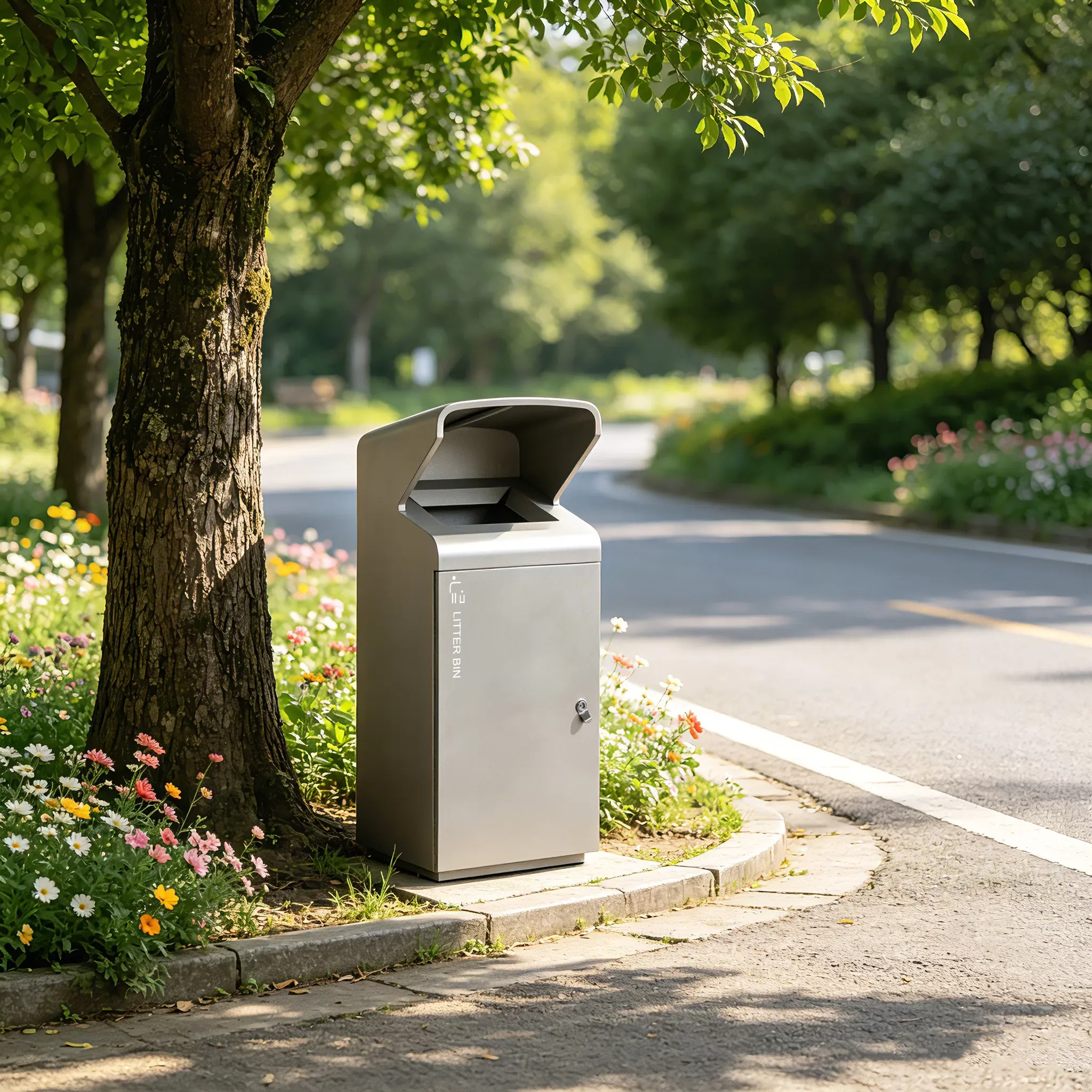
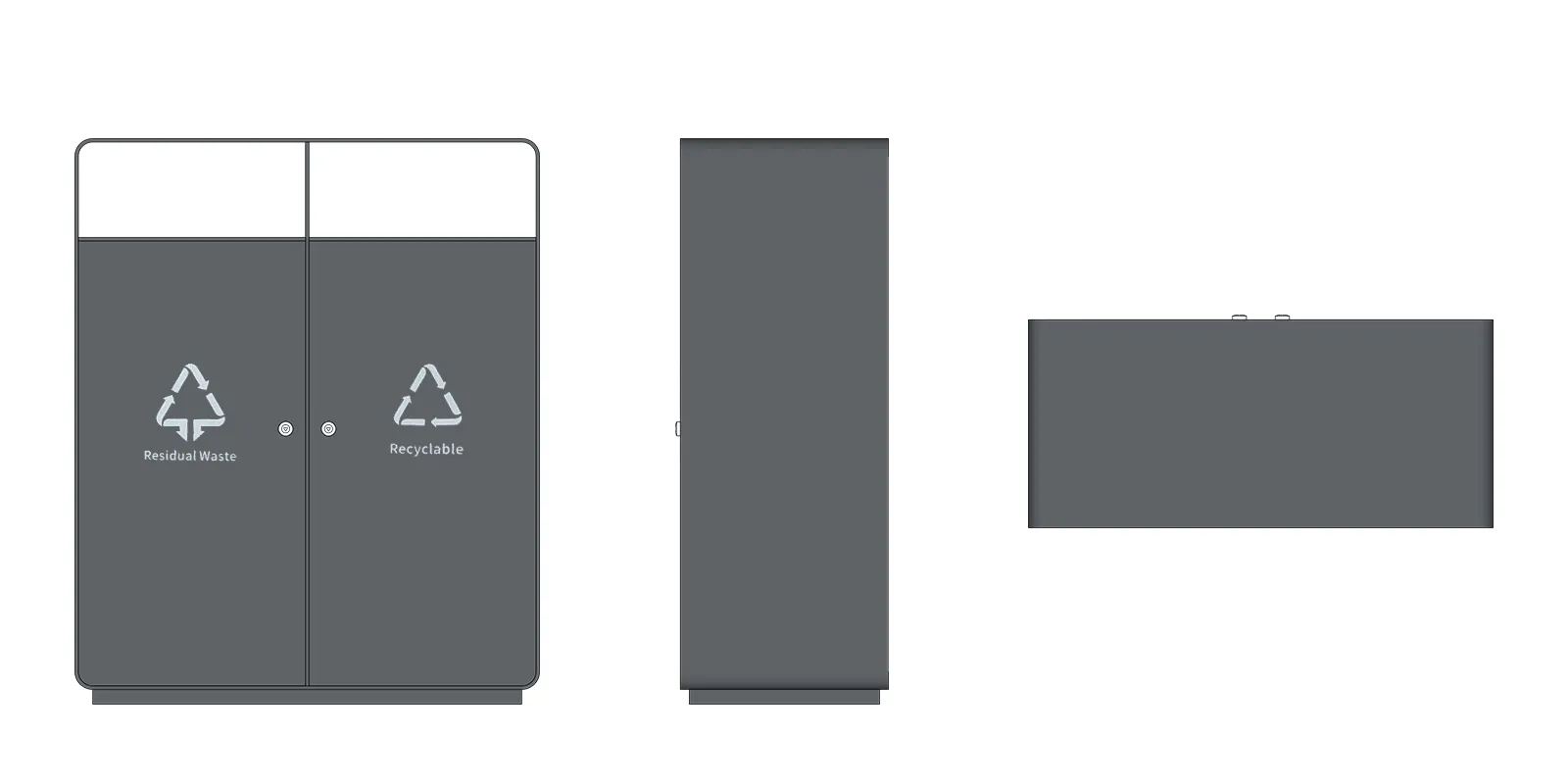
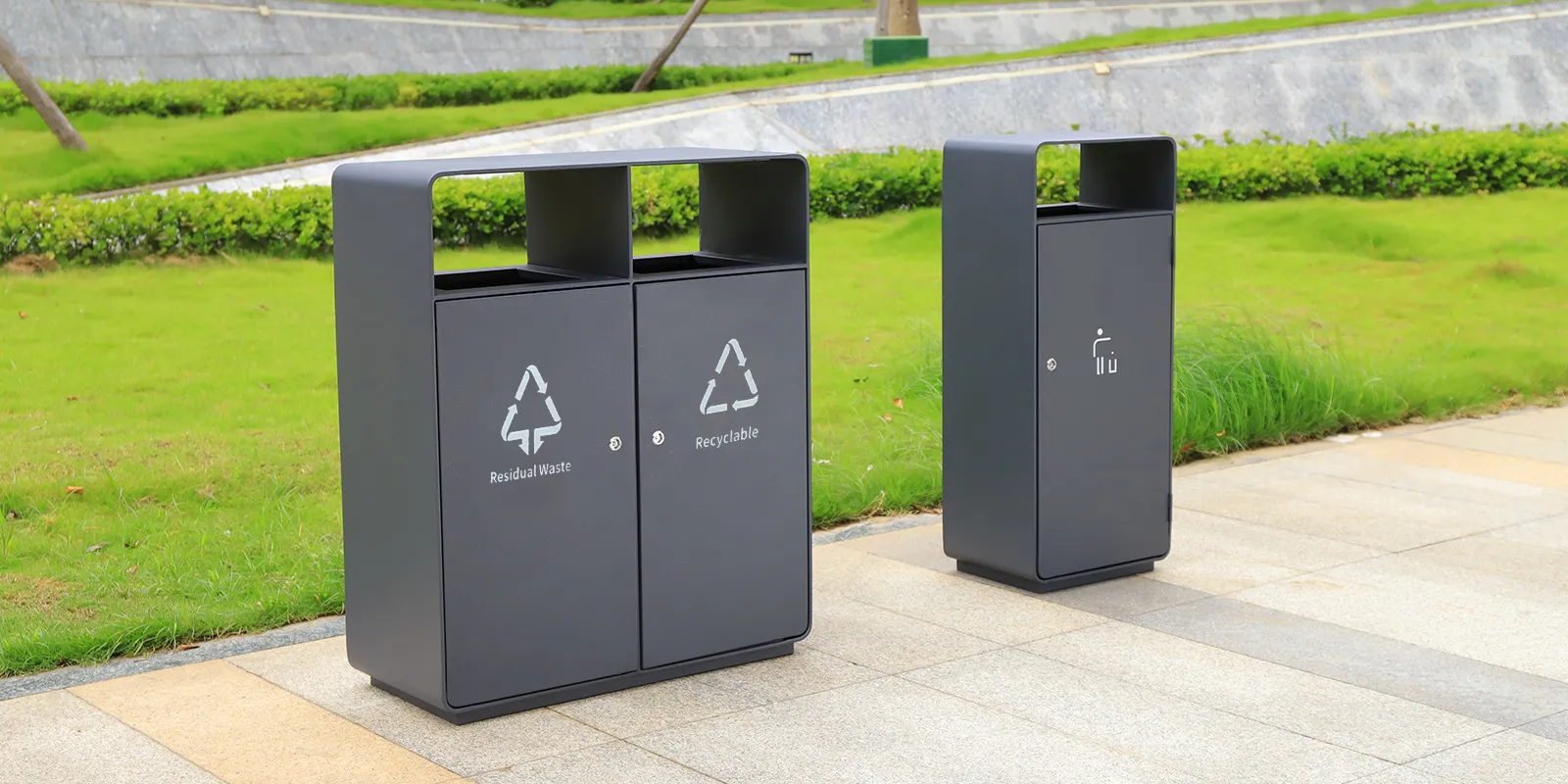
LVEN’s OTB-04 provides a reference for comparing covered openings and front servicing. Its powder-coated galvanized-steel construction includes a curved top cover, lockable front doors and removable metal inner liners. The single configuration holds 55 litres; the dual cabinet provides two separate 60-litre compartments.
The cover provides overhead shelter while leaving the disposal opening open. Its suitability should therefore be assessed against the location’s actual wind and rain exposure. For dimensional planning, the single cabinet measures 40 × 30 × 95 cm and the dual cabinet 78 × 35 × 95 cm. These closed dimensions exclude the additional space needed to open the doors and remove the liners.
Compare the features against the approved brief. A metal cabinet or coated finish does not establish hazardous-area approval or suitability for flammable waste. If the project requires specific fire-performance or other technical documentation, identify it explicitly and confirm availability for the selected configuration.
How Should Gas Station Waste Bins Be Emptied and Checked?
Size each compartment for the waste arriving between realistic collection opportunities. Commuter peaks, lunchtime food sales and car-wash queues can produce different loads. Record when staff can complete a collection round alongside their other duties.
For gas station waste bins, inspect each stream immediately before servicing. Note approximate fullness, recurring incorrect items, leaks, loose litter, blocked openings and the time since the previous visit. A station’s total volume can hide a problem in one compartment while another remains largely unused.
Read the pattern before changing equipment. An overflowing residual-waste section beside a lightly used recycling section may require a different capacity allocation. Cups lodged at the opening while the liner remains partly empty suggest an aperture problem. Incorrect items recurring in one stream may point to unclear instructions or labels that do not reflect what the store sells.
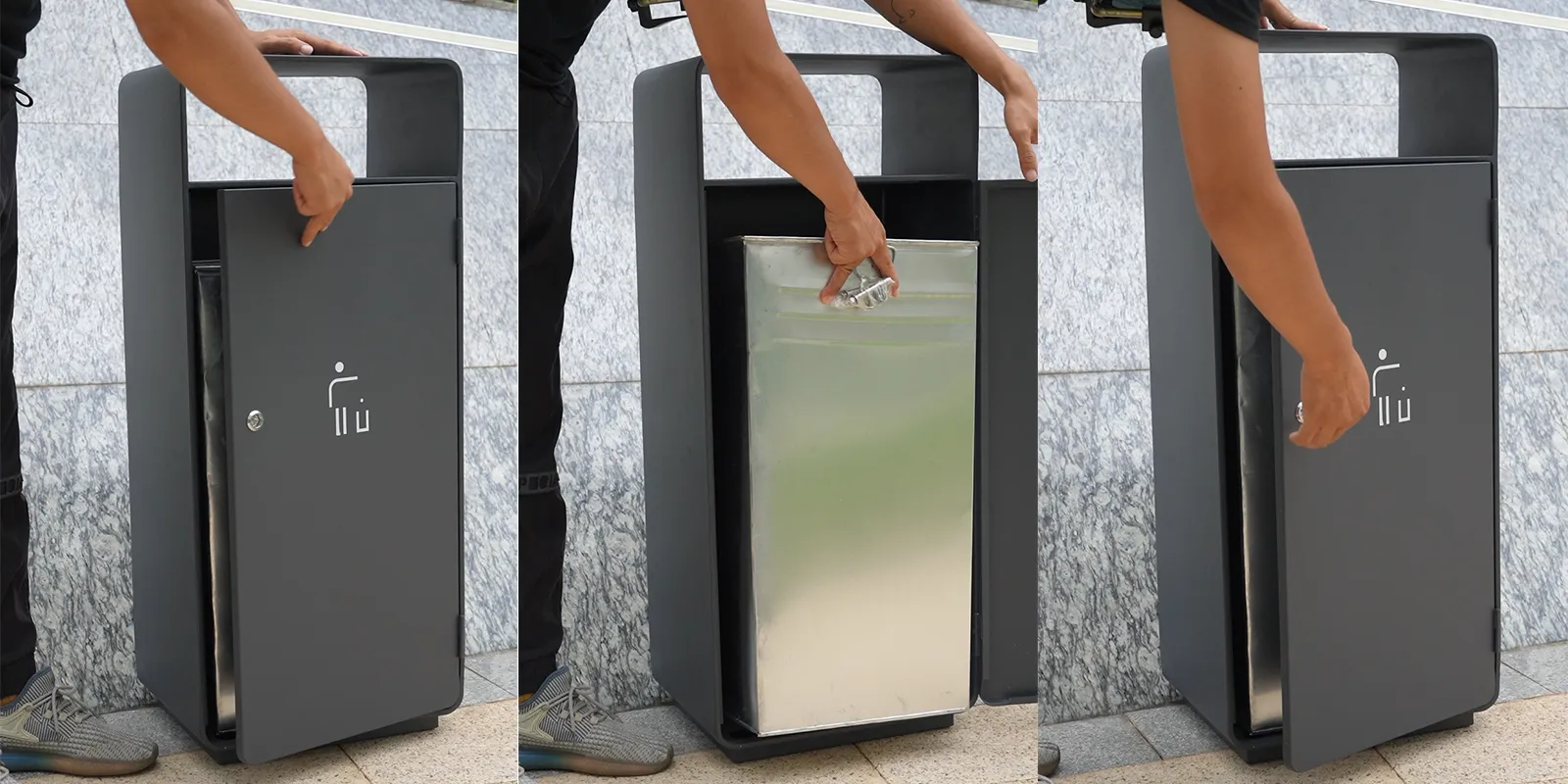
Trial the full removal sequence with the intended bag and representative contents. Check whether the service door remains in its intended position, the bag releases without catching and the loaded liner clears the access opening. Staff should be able to transfer it to the designated cart and fit a replacement without moving the fixed cabinet.
Preserve separation during transfer and storage wherever the collection contract requires it. Clear customer labels have limited value if staff combine the materials before contractor collection. Identify the storage destination and handover process for each stream.
Assign responsibility by location and shift, with a reporting route for overflow between scheduled rounds. Following a spill or discovery of unexpected material, staff should use the relevant site procedure. Include the cabinet and surrounding surface in the cleaning scope, with approved methods for managing any contaminated wash water.
What Belongs in a Forecourt Recycling Bin Project Schedule?
Convert the approved layout into a location schedule before comparing quotations. Give each point a reference linking the site plan, product configuration, label artwork and collection instructions.
For each reference, record the intended waste streams, required capacity per stream, closed dimensions, exposure and service-access direction. Distinguish candidate locations from positions already approved for installation. This prevents a preliminary procurement drawing from being treated as permission to install beside operating equipment.
When requesting custom trash bins, state what needs to change and why. A colour or logo requirement is different from a change to the opening, liner or cabinet dimensions. Include the actual packaging that must pass through each opening and any restrictions on the collection method.
Request drawings showing the service position as well as the closed product. Confirm included inner liners, bag-retention details, fixing scope, required documentation, sample approval and quantities by configuration. Ask about replacement parts for the selected model and order, rather than assuming components are interchangeable across a range.
Compare LVEN’s outdoor trash-bin range and commercial recycling bins against those requirements. Project-specific materials, finishes, labels and structural changes should be reviewed for feasibility before the specification is released for production.
Send LVEN the site plan, approved locations, waste streams, quantities and service method for a project quotation. Photographs of restricted spaces and the intended liner-removal route help make the equipment review more specific.
FAQ About Forecourt Waste and Recycling Bins
Should recycling be available near a convenience-store entrance?
Where customers discard accepted recyclable items there, a visible grouped station can be useful. Confirm the collection service and applicable requirements, while preserving door movements and pedestrian access. An entrance station does not automatically replace disposal points serving drivers who remain beside their vehicles.
Can the same bins be used inside the shop and outside?
Sorting language can remain consistent where the same streams are collected, but equipment requirements differ. Check outdoor exposure, opening design, fixing and service access separately. An indoor cabinet should not be selected for an exterior location solely because its appearance matches.
What capacity should forecourt litter bins have?
Choose capacity per stream using observed waste volumes, peak demand and the interval between achievable collection rounds. There is no single litre value suitable for every forecourt. A repeatedly full compartment may need more capacity, earlier collection or a different allocation within the station.
Are general outdoor bins suitable for fuel-contaminated waste?
Do not assume they are. Keep ordinary customer litter separate from fuel-contaminated materials and follow the operator’s designated procedures. Cabinet material, appearance and locking features do not establish a fire rating, hazardous-area approval or compatibility with those contents.
Contents